


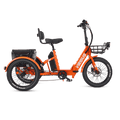


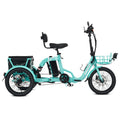



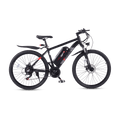




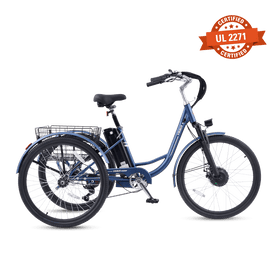
At first glance, an adult tricycle looks exactly like a standard bicycle with a comforting bonus wheel for balance. But if you walk behind the rider’s seat, you’ll find that the similarities quickly fall away.
While the front half steers and pedals just like a traditional bike, the rear drivetrain is an entirely different beast of mechanical engineering. It has to solve problems a two-wheeler never faces, like how to deliver power across two wheels without causing the vehicle to skid or resist turning.
How Does a Tricycle Work?

A tricycle works by transferring the rider's pedaling power through a chain to a rear drivetrain that rotates a solid rear axle. On most adult tricycles, the chain turns a cassette mounted on one side of the axle, which then drives the axle and powers one rear wheel, while the other rear wheel spins freely to allow smoother turning.
The front wheel is responsible for steering, just like on a regular bicycle, while the two rear wheels provide added stability and balance. Some tricycles use a single-chain drivetrain, while others use a dual-chain system with an intermediate axle for additional gear reduction. This unique rear axle design allows a tricycle to remain stable at low speeds and when stopped, making it easier and safer to ride than a traditional two-wheeled bicycle.
The Front of the Tricycle Works Like a Bicycle

The front section of most adult tricycles functions almost exactly like a standard bicycle. The handlebars control the front wheel, and the pedals turn the crankset to drive the chain. Steering, braking, and gear shifting all feel familiar to anyone who has ridden a bicycle before. The major differences begin at the rear of the tricycle, where the drivetrain must accommodate two wheels instead of one.
The Anatomy of the Rear Axle Assembly

While a standard bicycle relies on a compact rear hub suspended between two frame dropouts, an adult tricycle requires a robust, load-bearing live-axle or split-axle assembly.
The rear axle is essentially a solid steel or aluminum rod that spans the entire width of the trike's rear frame. It is supported by sealed cartridge bearings or pillow block bearings bolted directly to the tricycle’s subframe. These bearings must handle not only radial loads (the downward weight of the rider and cargo) but also lateral axial loads (the sideways forces generated when cornering).
The Cassette Adapter and Power Transfer
Because the axle must rotate to drive the vehicle, components cannot be threaded directly onto it as they are on a bicycle. Instead, manufacturers use a cassette adapter (or freewheel adapter).
- The Interface: This adapter is a hollow cylindrical sleeve that slides over the axle. The exterior of the sleeve is splined to accept a standard bicycle cassette or threaded for a single-speed freewheel.
- The Braking Integration: In many modern designs, this adapter is a dual-purpose component. It features mounts for the multi-speed cassette on one side and a standard 6-bolt or Centerlock interface for the disc brake rotor on the other. This ensures that both acceleration (pedaling) and deceleration (braking) forces are managed by the same structural hub.
The Mechanics of the Keyway: Preventing Free Spin
The connection between the cassette adapter and the smooth, round rear axle is a critical failure point if not engineered correctly. To lock these two rotating bodies together, engineers utilize a keyway system.
- The Machining: A longitudinal slot (the keyway) is precisely machined into the outer surface of the axle. A matching internal slot is broached into the inner bore of the cassette adapter.
- The Key: A small, rectangular or square piece of hardened steel—known as a parallel key or Woodruff key—is inserted into the axle's slot.
- The Engagement: When the cassette adapter is slid over the axle, the key bridges the gap between both slots. This mechanical interference entirely eliminates relative rotation between the adapter and the axle.
Maintenance Insight: If a tricycle's pedals spin freely but the vehicle doesn't move, a sheared key is a prime suspect. If the retaining set-screws back out, the key can slip out or become deformed under high torque loads, disconnecting the pedals from the wheels entirely.
The Physics of Cornering: Why One Wheel Spins Free
The decision to power only a single rear wheel (typically the right wheel) is a deliberate engineering solution to a fundamental physics problem: differential wheel speed during cornering.
The Tracking Problem
When any four-wheeled or three-wheeled vehicle makes a turn, the outside wheel must travel a longer, wider arc than the inside wheel.
If both wheels were locked to a solid axle and forced to spin at the exact same speed:
- Tire Scrubbing: One or both tires would be forced to slip or skid against the pavement to compensate for the speed discrepancy.
- Handling Resistance: The trike would actively resist turning, wanting to push straight ahead (understeer).
- Frame Fatigue: Intense torsional stress would twist the axle and frame every time the rider turned.
The Single-Wheel Drive Solution
By rigidly fixing only the drive wheel to the axle and allowing the free wheel to ride on independent ball bearings, the trike solves this problem without complex machinery. When turning, the free wheel can spin faster or slower as needed, matching the ground speed of its specific arc perfectly.
Advanced Alternative: The Tricycle Differential
Higher-end or industrial cargo tricycles sometimes bypass the single-wheel drive limitations by using an open mechanical differential—similar to what is found in a car.
|
System Type |
Traction |
Cornering |
Complexity & Cost |
|
Single-Wheel Drive |
Moderate (can slip on loose gravel/ice if weight shifts). |
Smooth and natural. |
Low complexity; easy to repair. |
|
Mechanical Differential |
High (splits torque to both wheels simultaneously). |
Perfectly smooth; allows independent wheel speeds. |
High complexity; significantly more expensive and heavier. |
Wheel-to-Axle Hub Interfaces
Because the drive wheel must turn with the axle and the free wheel must spin around the axle, their mounting strategies diverge completely.
The Peg-and-Hole (Drive Plate) System
This is the standard for consumer trikes. The drive side of the axle features a permanently welded or keyed flange (a drive plate) equipped with 3 to 5 protruding steel pegs.
- The drive wheel hub has a matching faceplate with holes drilled to slide directly over these pegs.
- A large axle nut and washer lock the wheel laterally against the plate.
- The Benefit: Torque is distributed across multiple shear points (the pegs), reducing stress on the wheel hub shell.
The Flat Axle (D-Shaped) System
Commonly found on heavy-duty or utility trikes, the ends of the axle are machined flat on one or more sides, creating a "D" shape or a double-D shape.
- The internal bore of the wheel hub is cast or broached with the exact same profile.
- The Benefit: This eliminates the need for external pegs, creating a highly reliable, zero-slop connection that cannot back out as long as the main axle bolt remains tight.
Single-Chain vs. Dual-Chain Mechanics
Not every tricycle uses the same drivetrain layout. Many geared adult tricycles use a single chain that runs directly from the pedals to the cassette on the rear axle. This design is relatively simple, lightweight, and easy to maintain.
Some tricycles, particularly certain single-speed models, use two chains instead. In these systems, the pedals drive a secondary shaft using the first chain. A second chain then transfers power from that shaft to the main rear axle. This arrangement can provide additional gear reduction, making it easier to start from a stop or carry heavier loads. It also allows manufacturers greater flexibility in frame and drivetrain design.
Single-Chain Layout
In a single-chain setup, an extra-long bicycle chain runs directly from the front chainring to the rear cassette. Because of the extreme distance (often over 4 to 5 feet), these systems require chain idler pulleys mounted under the frame to prevent the chain from sagging, slapping against the frame, or dropping off the gears entirely.
Why Your Bike Chain Keeps Falling Off (And What To Do About It)
Dual-Chain (Jackshaft) Layout
A dual-chain setup splits the drivetrain into two distinct stages via an intermediate shaft called a jackshaft.
- Primary Stage: The rider pedals, driving a chain that connects to the input sprocket of a mid-frame jackshaft.
- Secondary Stage: The jackshaft rotates across the width of the frame, spinning an output sprocket on its opposite side. A second, shorter chain runs from this output sprocket to the rear axle cassette.
Why use a dual-chain system?
- Torque Multiplication: It allows for two stages of gear reduction, letting manufacturers build ultra-low gearing configurations ideal for heavy industrial loads or steep hill climbing.
- Ground Clearance: It allows the rear chain to be incredibly short, keeping it tucked high up within the rear subframe out of the way of obstacles, dirt, and debris.
- Frame Optimization: It permits a step-through frame design without requiring an awkwardly routed, dangerously long single chain.
Final Words
When you pull back the curtain on the adult tricycle, it becomes clear that it’s far more than just a bicycle with an extra wheel. From the clever simplicity of the keyed axle to the intentional physics behind single-wheel drive systems, every single component is working hard to balance efficient power with rock-solid stability.
Understanding these inner workings doesn't just make you a more informed rider—it makes troubleshooting a slipping pedal or adjusting a dual-chain system a breeze. The next time you take your trike out for a spin, you’ll know exactly what’s happening beneath the frame with every revolution of the pedals. Happy riding, and keep those chains clean!
FAQ
Why is it difficult to ride a tricycle?
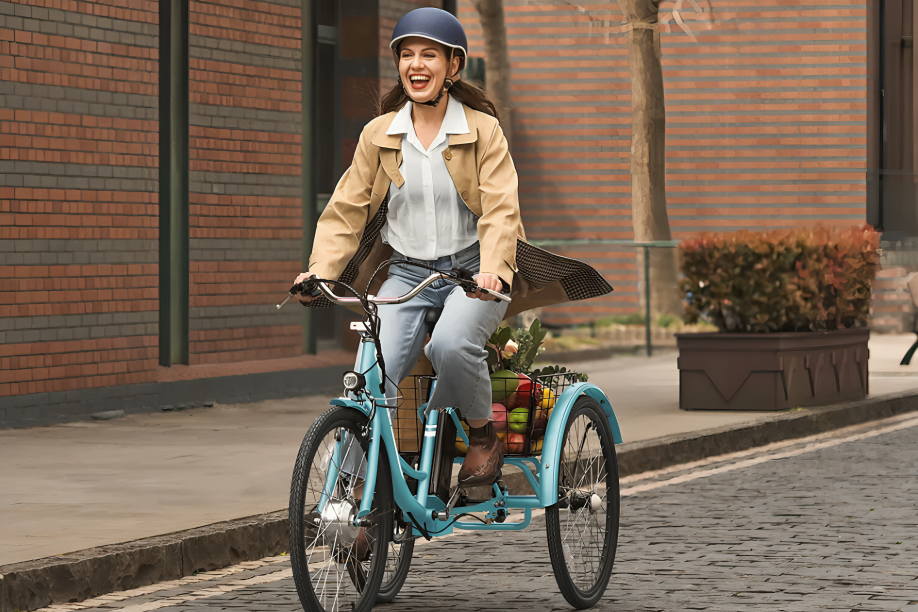
Although tricycles are more stable than bicycles, they can feel difficult to ride at first because they handle differently. Unlike a bicycle, a tricycle does not lean into turns, so riders must slow down and steer more carefully to prevent the inside wheel from lifting during sharp corners. Adult tricycles are also wider and heavier, which can make maneuvering through tight spaces and navigating uneven terrain more challenging. Most riders adapt quickly after a few practice rides.
How to Ride an Adult Tricycle: The Right Way
Do you have to pedal an electric tricycle?
Yes, most electric tricycles require some pedaling when using pedal-assist mode, where the motor only provides assistance as you pedal. However, many e-trikes also include a throttle that allows you to move without pedaling, depending on the model and local regulations. Even with motor assistance, pedaling helps extend battery range, improves efficiency, and provides light exercise during your ride.
Are tricycles manual or automatic?
Most tricycles are manual, meaning the rider powers them by pedaling just like a traditional bicycle. Electric tricycles, however, combine manual pedaling with an electric motor that automatically assists the rider through pedal-assist technology or a throttle. While the motor reduces the effort needed to ride, the drivetrain itself is still mechanically operated rather than fully automatic like a motor vehicle transmission.
What are the disadvantages of tricycles?
Tricycles offer excellent stability, but they also have some drawbacks. They are generally heavier, wider, and more expensive than bicycles, making them harder to transport and store. Their wider rear axle requires more space on bike paths and trails, and because tricycles do not lean into corners, riders must take turns more slowly to maintain stability. Additionally, climbing steep hills on a non-electric tricycle can require more effort due to the extra weight. Despite these limitations, many riders find the added balance, comfort, and cargo capacity well worth the trade-offs.












Leave a comment
All comments are moderated before being published.
This site is protected by hCaptcha and the hCaptcha Privacy Policy and Terms of Service apply.