


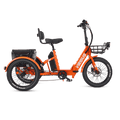


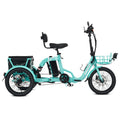







Imagine cruising at top speed with the stability of three wheels beneath you, feeling zero tipping anxiety as you take on commutes, hills, or cargo runs. That is the exact sweet spot high-speed electric tricycles are carving out in modern micromobility.
While traditional trikes were once known almost exclusively as slow, low-speed cruisers capped at 12 to 14 mph for stability, a new generation of high-powered engineering has completely rewritten the rules. Today's top-tier e-trikes boast frame-mounted motors, advanced differential rear axles, and dual-battery configurations capable of reaching 20 to 28+ mph—with specialty and concept models pushing speed boundaries even further.
How Fast Can an Electric Tricycle Go?

While standard electric tricycles for adults are capped between 15 and 20 mph for balance and legal compliance, performance-engineered e-trikes can easily reach speeds of 28 to 30+ mph.
Factors like higher-wattage motors (750W–1500W+), 52V battery architecture, low-center-of-gravity recumbent frames, and differential axles allow these specialized models to deliver higher top-end velocities safely without sacrificing stability.
Entry-Level Models (10–15 mph)
Designed primarily for seniors, adaptive riders, or casual neighborhood errands. These trikes feature low step-through frames and smaller motors (typically 250W–350W) focused on gentle acceleration and steady balance.
Standard Commuter E-Trikes (15–20 mph)
The most common category on the market today. Powered by 500W to 750W hub motors, these models easily keep pace with urban bike lanes and Class 2 legal guidelines (which cap throttle speed at 20 mph).
Performance Models (20–28 mph)
Premium commuter and recumbent e-trikes engineered with specialized differential rear axles or lower centers of gravity. These can operate under Class 3 speed limits, giving confident riders the extra push needed for long-distance transit or heavy cargo hauls.
3-Speed vs. 7-Speed Adult Tricycles: Which Is Better for an Elderly Rider?
Adult Single-Speed Tricycle: The Ultimate Buyer’s Guide
Fastest Electric Tricycle Speed Comparison
|
Type of Electric Tricycle |
Typical Top Speed |
Best For |
|
Standard e-trike |
15–20 mph |
Daily riding |
|
Commuter e-trike |
20–25 mph |
City transportation |
|
Performance e-trike |
25–30 mph |
Speed-focused riders |
|
Modified/high-power e-trike |
30+ mph |
Experienced riders |
Factors That Affect Electric Tricycle Speed

An electric tricycle’s speed isn’t just about putting a bigger motor on a frame. Achieving higher speeds safely requires an integrated system where motor output, battery architecture, frame aerodynamics, and tire efficiency all work together.
Electric Motor

In the world of e-trikes, motor wattage (W) measures work capacity—think of it as the raw muscle of the vehicle. Higher wattage translates directly into greater torque and higher top-end speeds, allowing the trike to overcome aerodynamic drag and climb hills without losing momentum.
- 250W–500W Motors: Standard for entry-level and leisurely urban trikes. These motors provide smooth assistance up to 12–16 mph. They excel at low-speed stability and flat-ground cruising, but struggle to push past 18 mph under heavy cargo loads or up inclines.
- 750W Motors: The sweet spot for high-performance commuter trikes. A 750W motor delivers enough output to reach legal Class 2 and Class 3 limits (20–28 mph). It provides strong throttle acceleration off the line and comfortably maintains higher speeds on moderate hills.
- 1000W+ Motors: Found on off-road, cargo, and custom high-speed trikes. Unrestricted 1000W to 1500W+ powertrains easily push trikes past 30 mph. They deliver massive torque to maintain top speeds regardless of payload or steep grades, though they require heavy-duty braking systems to control safely.
Battery Capacity and Range

Aerodynamic drag increases exponentially as you speed up: pushing through wind resistance at 28 mph requires roughly four times the power than cruising at 14 mph. Because fast riding drains energy at a rapid pace, a fast e-trike relies heavily on three key battery metrics:
|
Battery Metric |
What It Controls |
High-Speed Impact |
|
Voltage (V) |
Potential electrical pressure |
Higher voltage (48V–52V+) pushes more power to the controller, enabling faster acceleration and higher top speeds without motor lag. |
|
Amp-Hours (Ah) |
Fuel tank capacity |
Higher Ah (15Ah–20Ah+) determines how long the battery can sustain high current draw before voltage sag limits your top speed. |
|
Watt-Hours (Wh) |
Total energy stored |
Higher Wh (720Wh–1000Wh+) ensures you don't run out of range in just a few miles when riding at continuous full throttle. |
Frame Design and Weight
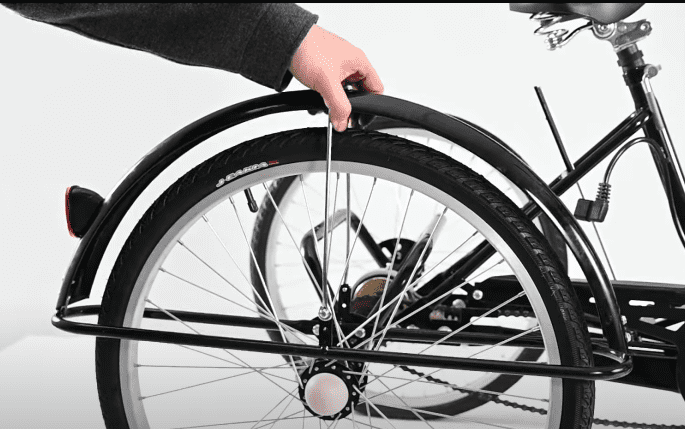
How an e-trike handles high speeds comes down to its structure and drag reduction:
- Lightweight Aluminum Frames: High-grade 6061 or 7075 aluminum alloys keep overall vehicle weight low. Less mass means the motor converts more electrical energy into forward speed rather than dragging dead weight.
- Aerodynamic & Recumbent Layouts: Upright cargo trikes create a massive "sail effect" against oncoming wind. In contrast, recumbent trikes and adaptive trikes seat the rider low to the ground, dramatically cutting frontal surface area to slice through wind resistance with ease.
- Efficient Drivetrain Systems: High-speed trikes rely on specialized rear differential axles (which distribute power to both rear wheels independently) or high-efficiency mid-drive motors paired with multi-speed gear hubs. This prevents drivetrain power loss and ensures smooth power delivery during high-speed cornering.
Tires and Suspension

Getting speed to the ground while staying in control depends entirely on your contact points with the pavement:
- Tire Tread & Rolling Resistance: Deeply knobby off-road fat tires create friction and slow you down on asphalt. High-speed road trikes use slick or semi-slick street tires with low rolling resistance, maximizing top-end speed while saving battery life.
- Tire Diameter: Larger 24" or 26" front wheels cover more linear distance per pedal stroke or motor revolution compared to compact 20" wheels, making high speeds easier to sustain.
- Full Suspension Control: At 25+ mph, hitting a pothole or bump on a rigid three-wheeler can compromise your steering line. Dual front suspension arms (or a full-suspension chassis) absorb road shocks, keeping all three wheels firmly planted on the road for stable high-speed handling.
Are Folding Electric Tricycles Faster?
Are Fast Electric Tricycles Safe?

Fast electric tricycles can be remarkably safe, but their safety depends entirely on how they are designed, how they are ridden, and whether the speed matches the trike's engineering.
While three wheels offer distinct balance advantages over two-wheeled bicycles, high speeds introduce unique physics that require dedicated safety technology and proper riding technique.
Three Wheels
For many riders, an electric tricycle provides a level of security that a two-wheeled e-bike simply cannot match.
Unlike standard bikes that require constant micro-adjustments to stay upright, an e-trike is inherently self-balancing. You don't need to put your feet down at stoplights, on steep inclines, or while waiting in traffic.
Most e-trikes feature ultra-low step-through frames. Combined with three-point ground contact, getting on and off is simple and steady, making them ideal for carrying heavy cargo or for riders with joint stiffness.
Because you never have to worry about tipping over while standing still or moving at slow speeds, trikes remove the baseline anxiety of balancing—allowing riders to focus entirely on navigation and road safety.
Safety Challenges at Higher Speeds
When you take a three-wheeled vehicle past 15–20 mph, the laws of physics change significantly. Understanding these challenges is key to riding safely:
- Heavier frames (often 70–100+ lbs) combined with high momentum mean that stopping at 25 mph takes roughly four times the distance required at 12 mph.
- Two-wheeled bicycles lean into a curve to counter centrifugal force. Rigid upright trikes stay flat, meaning sharp turns at high speed push energy outward, which can lift the inner rear wheel off the ground.
- In the event of a collision, higher speed exponentially increases impact energy.
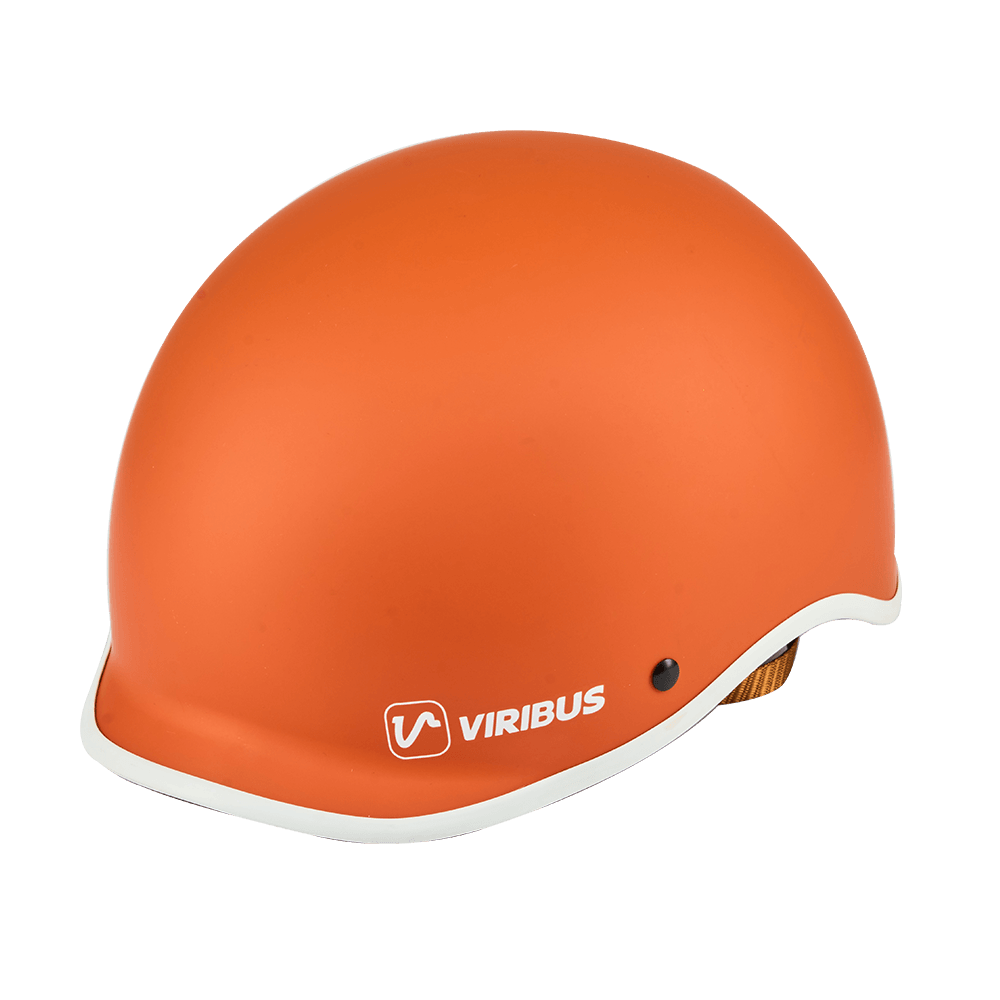
- A quality helmet (preferably DOT or NTA 8776 certified for speed) is non-negotiable. High-visibility clothing, eye protection, and gloves are also essential when traveling over 20 mph.
Features That Improve High-Speed Safety
If you plan to ride at speeds above 15 mph, look for models equipped with these essential safety components:
|
Safety Feature |
Why It Matters for High Speeds |
|
Hydraulic Disc Brakes |
Hydraulic systems require far less hand pressure while delivering immediate, fade-resistant stopping power—crucial for heavy high-speed trikes. Look for models with dual rear rotors or a centralized rear-axle disc. |
|
Rear Differential Axle |
Allows the two rear wheels to spin at different speeds during a turn. This prevents wheel drag, eliminates sudden steering resistance, and keeps corners smooth and planted. |
|
Integrated LED Lighting |
Bright front headlights, rear brake lights that illuminate when levers are pulled, and built-in turn signals ensure drivers can see your wider footprint on the road. |
|
Full Suspension System |
Front suspension forks and rear shock absorbers keep all three tires in full contact with the pavement over bumps and potholes, preserving your steering track at speed. |
|
Selectable Speed / Class Settings |
Digital display controls that let you cap top speeds (e.g., a "Beginner Mode" limited to 8–12 mph for busy trails, and a "Standard Mode" for open roads) give you total control over power delivery. |
Viribus SC5 Fast 24 mph Fat Tire Electric Tricycle

The Viribus SC5 Fat Tire Electric Tricycle delivers the ideal blend of stable three-wheeled balance, high-speed performance, and modern technology for confident daily riding.
Powered by a 48V 500W motor (750W peak) and a removable 48V 15Ah (720Wh) automotive-grade battery, this versatile e-trike reaches speeds of up to 20 mph on half-twist throttle and 24 mph on dual-sensor pedal assist.
Complete with high-output integrated LED lights, a quick 4-to-6-hour smart charger, and a 2.5-inch backlit LCD display featuring Bluetooth map navigation, the Viribus SC5 makes carrying cargo, climbing hills, and cruising local roads effortless and safe.

|
Feature |
Specification |
|
Motor |
48V, 500W (Peak 750W) Brushless Hub |
|
Top Speed |
20 mph (Throttle) / 24 mph (Pedal Assist) |
|
Battery |
48V 15Ah (720 Wh) Automotive-Grade Battery |
|
Battery Weight |
8.6 lb. (3.9 kg) |
|
Sensors |
Dual Hall Cadence Sensors |
|
Throttle |
Removable Half-Twist Throttle |
|
Lighting |
Integrated High-Output LED Headlight & Taillight |
|
Display |
2.5" Backlit LCD with Bluetooth & Turn-by-Turn Map Navigation |
|
Charger |
48V, 2.0A Smart Charger (4–6 Hour Full Charge) |
How to Increase Electric Tricycle Speed Safely

If you want to get the best top speed and peak efficiency out of your electric tricycle, you don't necessarily need to swap out the motor or modify the electronics. In fact, bypassing factory speed limiters can strain your controller, overheat the motor, and void your warranty.
The safest and most reliable way to boost your e-trike's speed is through routine maintenance, optimizing your setup, and reducing unnecessary drag.
Proper Tire Pressure
Tire pressure is one of the most overlooked factors when it comes to e-trike speed and range.
Riding on soft, underinflated tires increases the rubber's contact patch with the pavement. This creates excessive rolling resistance, forcing your motor to work harder just to maintain momentum.
Inflate your tires to the higher end of the manufacturer’s recommended PSI (usually printed directly on the tire sidewall). Harder tires minimize drag, instantly improving top-end velocity and extending battery range per charge.
Keep the Battery Healthy
Your e-trike’s motor relies on consistent electrical voltage from the battery pack to reach its top speed. As a battery degrades or drops in charge, it experiences voltage sag, which noticeably reduces top-end acceleration.
Constantly draining your battery to 0% damages the internal cells and lowers the pack's overall voltage efficiency.
Extreme cold slows down chemical reactions inside lithium-ion cells, causing severe power drops. Extreme heat degrades battery life. Store and charge your battery pack in a dry, climate-controlled space.
Reduce Unnecessary Weight
Every extra pound your e-trike carries forces the motor to draw more amperage to keep moving.
- Clear Out Heavy steel front baskets, large rear cargo boxes, unused locks, and extra tools add up quickly.
- Strip away heavy add-ons you don't use daily. A lighter frame allows your motor to reach its maximum RPM faster, particularly when accelerating from a complete stop or climbing hills.
Local E-Bike Speed Regulations
Before optimizing your trike for maximum performance, ensure you know the road rules in your region:
- United States: Federal guidelines and most state laws categorize e-bikes under a three-class system capped at 20 mph for Class 1 & 2 (throttle or pedal-assist) and 28 mph for Class 3 (pedal-assist).
- United Kingdom & Europe: Standard EN15194 regulations strictly cap motor assistance at 25 km/h (15.5 mph) with a maximum 250W continuous power limit. Exceeding these limits shifts the vehicle into a moped or speed-pedelec classification, requiring insurance, registration, and specialized licensing.
A Note on Rider Safety
Always follow the weight limits, electrical ratings, and speed limits recommended by your e-trike's manufacturer. Pushing an electric tricycle beyond its intended engineering limits can lead to frame stress, brake failure, or thermal damage to the motor controller.
FAQs
What is the fastest electric tricycle available?
The fastest electric tricycles available today can reach speeds of around 25–30+ mph, depending on the motor power, battery system, controller settings, rider weight, and riding conditions.
Can an electric tricycle go 30 mph?
Yes, some electric tricycles can reach 30 mph or more, especially models equipped with high-powered motors and large-capacity batteries.
Is a 1000W electric tricycle faster than a 750W model?
Generally, a 1000W electric tricycle can be faster than a 750W model because it provides more power for acceleration, hill climbing, and carrying heavier loads.
A higher-wattage motor allows the tricycle to maintain speed more easily on steep roads or with additional cargo.
However, top speed is also affected by battery voltage, controller settings, gearing, and overall design, so a well-designed 750W e-trike may still perform competitively.
What is the best motor size for an electric tricycle?
The best motor size for an electric tricycle depends on how and where you plan to ride. A 500W–750W motor is usually enough for everyday commuting, recreational rides, and moderate hills, offering a good balance between speed, efficiency, and battery range.
Riders who carry heavy cargo, ride on steep terrain, or want stronger acceleration may benefit from a 1000W or higher motor, although it may consume more battery power and require stronger braking systems.
Are electric tricycles allowed to go as fast as electric bikes?
Electric tricycles are not always allowed to travel at the same speeds as electric bikes because regulations vary by location and how the vehicle is classified.
Some areas apply the same speed limits to e-bikes and e-trikes, while others may have different rules based on motor power, throttle use, or vehicle type.
Before riding a high-speed electric tricycle on public roads or bike paths, it is important to check local laws and ensure the tricycle meets required safety standards.




![Are Electric Bikes UL Certified? [How to Verify]](http://viribusbikes.com/cdn/shop/articles/EDM_1.jpg?v=1787630110&width=1500)









Leave a comment
All comments are moderated before being published.
This site is protected by hCaptcha and the hCaptcha Privacy Policy and Terms of Service apply.