


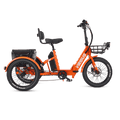


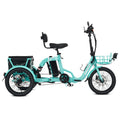



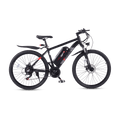


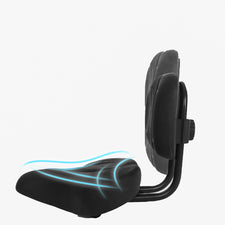


At first glance, an electric tricycle may appear to be a straightforward upgrade to a standard three-wheeler. But under the surface, it represents a clever blend of traditional mechanical design and modern battery technology.
An e-trike is a three-wheeled vehicle powered by a combination of manual pedaling and an electric motor drive system. While a traditional bicycle relies entirely on pedal power and human balance, and a standard tricycle provides three-wheel stability through pure legwork, an e-trike bridges the gap.
Understanding how these electric tricycle parts fit together isn't just useful for engineers — it's essential for riders. Knowing your e-trike’s inner workings helps you choose the right model for their terrain, empowers owners to perform routine maintenance, and makes it much easier to troubleshoot common issues before they turn into costly repairs.
1. Electric Tricycle Frame
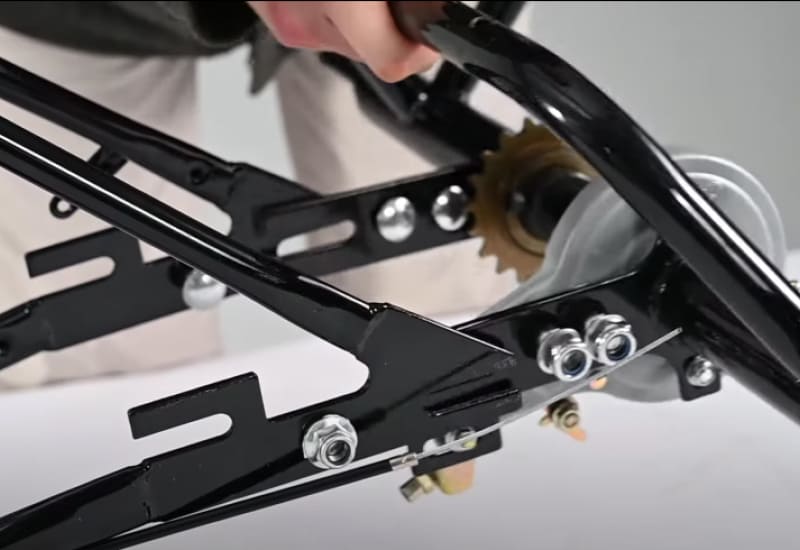
The main frame holds the entire vehicle together, bearing the stress of acceleration, braking, and road vibration. Because tricycles don't lean naturally into turns like two-wheelers, the frame experiences unique lateral (side-to-side) forces that demand robust construction.
Frame Materials
- Aluminum Alloy (6061 / 7075): Lightweight and highly resistant to rust and corrosion. Aluminum frames make the e-trike easier to pedal manually and maneuver, making them the most popular choice for commuter and recreational models.
- Steel (High-Tensile or Chromoly): Exceptionally strong, durable, and forgiving over rough terrain. Steel provides superior tensile strength and naturally absorbs road vibrations, making it the material of choice for heavy-duty commercial e-trikes and high-capacity cargo models, though it is noticeably heavier.
2. Electric Motor

If the frame is the skeleton of an electric tricycle, the motor is its muscles. The electric motor converts electrical energy from the battery into mechanical energy, driving the wheels forward and reducing the effort needed to pedal a heavy three-wheeled vehicle.
Working Principles of Electric Tricycle Motor Systems
Hub Motors

The vast majority of consumer electric tricycles rely on hub motors, which are self-contained electric motors sealed directly inside the center hub of a wheel. Hub motors are popular because they are durable, low-maintenance, and operate independently of your traditional chain drive.
|
Feature |
Front Hub Motor |
Rear Hub Motor |
|
Placement |
Integrated into the single front wheel |
Integrated into one (or both) rear wheels |
|
Weight Distribution |
Pulls the trike from the front, balancing rear-heavy cargo |
Pushes from the back, directly under rider weight |
|
Traction |
Can slip on steep loose gravel or wet ground if unweighted |
Excellent traction due to heavy rear axle weight |
|
Installation & Repair |
Simple design; easy to drop front wheel for tire changes |
More complex wiring and integration with rear drivetrain |
|
Best Used For |
Flat urban commuting and basic recreational cruising |
Heavy cargo hauling, steep inclines, and off-road terrain |
Mid-Drive Motors
While hub motors dominate the market, some premium cargo e-trikes use mid-drive motors positioned at the bottom bracket (where the pedals meet). Mid-drives power the trike through its mechanical gears, offering exceptional torque for steep hills, though they carry a higher price tag.
Motor Power Ratings
|
Power Rating |
Best For |
Typical Speed Range |
Ideal Terrain & Payload |
Primary Advantage |
|
250W – 350W |
Casual riding, adaptive mobility, light errands |
12 – 18 mph |
Flat city streets, paved bike paths, light payloads |
Maximum battery range and highly energy-efficient |
|
500W |
Daily urban commuting, moderate grocery hauling |
15 – 20 mph |
Rolling hills, overpasses, mixed urban terrain |
Best balance of speed, torque, and power efficiency |
|
750W+ |
Heavy cargo, heavy riders, steep mountain terrain |
20 – 28+ mph |
Steep inclines, rough off-road tracks, high payloads |
Maximum off-the-line torque and strong hill-climbing power |
How Motor Power Affects Performance
- Top Speed: Higher-wattage motors sustain top speeds (typically capped electronically at 15–28 mph) even under heavy drag or headwind.
- Hill-Climbing Ability: Wattage, combined with torque (measured in Newton-meters or Nm), determines how easily the e-trike can climb hills without stalling or requiring intense human pedaling effort.
- Carrying Capacity: A heavier trike loaded with goods requires substantially more power to get moving from a dead stop. High-wattage motors prevent strain and overheating when hauling heavy loads.
3. Electric Tricycle Battery

If the motor provides the muscle for an electric tricycle, the battery is its heart. It delivers the essential electrical energy needed to assist your pedaling, power heavy cargo loads, and climb hills with ease.
Modern e-trikes rely almost exclusively on Lithium-Ion (Li-ion) battery packs. They offer high energy density, a relatively lightweight footprint, low self-discharge rates, and predictable power output under load.
1. Voltage (V): The Electrical "Push"
Voltage determines how much power can flow to the motor. Higher voltage translates to snappier acceleration and better hill-climbing torque.
- 36V: Ideal for casual flat-ground cruising and lightweight riders.
- 48V: The industry standard for utility e-trikes, offering balanced power for commuting, climbing, and daily cargo.
- 52V: Premium high-performance setups designed for steep inclines, heavier loads, and sustained top speeds.
2. Amp Hours (Ah): The Fuel Tank Size
Amp hours measure charge capacity. A higher Ah rating means the battery can supply current for a longer duration before needing a charge.
Example:
A 48V 13Ah pack holds roughly 30% more total runtime than a 48V 10Ah pack under the same riding conditions.
3. Watt Hours (Wh): Total Stored Energy
Watt Hours give the truest picture of overall battery capacity because it accounts for both force (V) and capacity (Ah).
Watt Hours (Wh) = Voltage (V) × Amp Hours (Ah)
For example, a 48V 13Ah battery has approximately 624Wh of capacity. A higher Wh rating generally means more available energy and a longer potential range, making it an important specification for riders who plan longer commutes or frequent cargo trips.
Removable vs. Integrated Setup

- Removable Packs: Let you unlock the battery and take it indoors to charge. This is a major advantage if you park your trike in a cold garage or outdoor shed.
- Integrated Packs: Conceal the battery inside the main frame tubing for a sleek look and added protection against theft and weather. However, you must park the entire trike near an outlet to recharge.
4. Controller
While the battery stores energy and the motor provides raw strength, the controller is the unsung brain of an electric tricycle. Tucked safely inside a weatherproof metal box mounted to the frame, this compact computer acts as a central distribution hub. It decodes user inputs and manages the flow of electricity between every electronic part on the trike.
Without a controller, connecting a battery directly to a motor would dump full power into the wheels all at once. The controller prevents this by constantly sampling system signals and dynamically adjusting current (amperage) to the motor:
- Battery Management: Receives direct high-current DC power from the battery pack and converts it into precisely timed phase pulses to spin the brushless motor.
- Throttle Response: The throttle response system converts the rider’s input from a twist throttle or thumb throttle into smooth, controlled motor acceleration. When the rider adjusts the throttle, it sends a variable electrical signal—typically ranging from 1.0V to 4.2V—to the controller, which interprets the signal and determines how much power to deliver to the motor.
- Pedal Assist System (PAS): Reads cadence or torque sensors at the pedal crank. When you start pedaling, the controller instantly calculates the exact power level needed based on your selected assist setting.
- Safety Cut-Offs: Monitors integrated switches on your brake levers. The moment you pull a brake lever, the controller instantly cuts off motor power—ensuring the engine never fights your brakes, even if you are still holding the throttle.
5. Electric Tricycle Display and Control System

The display and handlebar controls serve as your command center. Together, they bridge the gap between human input and digital motor response, keeping critical riding metrics visible at a glance while ensuring your hands stay safely anchored to the handlebars.
LCD vs. LED Displays
Mounted directly in the center or left side of the handlebar, the display panel acts as the e-trike’s primary dashboard. Tricycles typically come equipped with one of two display technologies:
|
Feature |
LED Displays |
LCD / Color TFT Displays |
|
Interface |
Simple bar indicators & lit buttons |
Detailed digital screen with backlighting |
|
Data Shown |
Basic battery level & PAS stage |
Speed, distance, battery %, error codes, wattage |
|
Customization |
Minimal or none |
Deep settings (wheel size, speed limits, brightness) |
|
Best Used For |
Budget models, simple city cruising |
Daily commuting, heavy cargo hauling, long tours |
What Your Display Monitors
|
Display Metric |
What It Shows |
Primary Function & Benefit |
|
Battery Status |
Remaining voltage (V) or real-time percentage (%) |
Prevents unexpected power loss by providing an accurate gauge of remaining fuel—critical when carrying heavy loads far from home. |
|
Speedometer |
Current, average, and maximum speed (MPH / KM/H) |
Helps maintain a comfortable pace and ensures full compliance with local municipal bike-lane and trail speed regulations. |
|
Odometer & Trip Meters |
Single-trip distance (TRIP) and total mileage (ODO) |
Measures specific trip lengths and tracks overall vehicle usage to help schedule timely maintenance (e.g., brake pad checks or tire replacements). |
|
Pedal Assist Level (PAS) |
Active power assist mode (typically stage 0 through 5) |
Displays real-time motor output, allowing you to easily adjust support for hills or tone it down to extend battery range. |
|
Diagnostic Error Codes |
Specific error numbers or icons (e.g., E07, E24, E30) |
Instantly identifies electrical issues—such as motor hall sensor faults, voltage drops, or loose wiring—for faster troubleshooting. |
Handlebar Controls & Throttles

Conveniently positioned near the grips, ergonomic thumb buttons and throttles allow you to adjust motor behavior without ever taking your eyes off the road.
Master Power Switch: Initiates system boot-up. Most models require a 2-to-3 second press-and-hold safety delay to prevent accidental activation during parking or loading.
PAS Selectors (+ / −): Seamlessly toggles motor assistance levels up or down. Tap "+" for instant torque on steep hills, or tap "−" on flat terrain to conserve battery.
Throttle Controls: Delivers full motor power on demand without pedaling.
- Thumb Throttles: Lever-operated via thumb pressure—ideal for fine-tuned power bursts.
- Twist-Grip Throttles: Motorcycle-style control—great for continuous cruising effort.
- Utility: Critical for getting a heavy, static 3-wheeled load moving smoothly from a complete stop at intersections.
Integrated Light & Horn Controls: Quick-access toggle switches operate low-draw LED headlights, rear brake lights, and electric horns for night riding and city traffic safety.
6. Throttle and Pedal Assist System (PAS)

An electric tricycle gives you flexible options for how power reaches the wheels. You can engage the motor on demand using a manual throttle, or let the Pedal Assist System (PAS) deliver automatic power whenever you spin the cranks.
Throttle Systems
Throttles give you instant, on-demand acceleration without needing to pedal at all. They act as an electric accelerator, making them crucial for getting a heavy three-wheeler rolling from a complete stop—especially when loaded with cargo or stopped at an uphill intersection.
- Thumb Throttles: Mounted near the inner grip, these use a small spring-loaded lever operated by your right or left thumb. They are easy to control, leave your palms fully rested on the grips, and carry a low risk of accidental engages during sudden maneuvers.
- Twist Throttles: Functioning like a traditional motorcycle grip, twisting the inner section of the handlebar engages the motor. They feel natural for high-speed cruising, but require a firm grip and proper hand positioning to avoid unintended wrist activation when mounting or dismounting.
Pedal Assist System (PAS) Sensors
The Pedal Assist System measures your pedaling motion at the bottom bracket or crank arm, sending a digital signal to the controller to engage the motor automatically. How that assistance feels depends entirely on the type of sensor installed:
Top 8 Reasons Why Your Bike Is Too Hard to Pedal
|
Feature |
Cadence Sensor |
Torque Sensor |
|
Operating Principle |
Measures if you are pedaling and how fast the cranks spin. |
Measures how hard (effort) you press down on the pedals. |
|
Power Delivery |
On/Off switch feel: Sends a fixed amount of motor power based on your selected PAS level, regardless of leg effort. |
Proportional feel: Seamlessly scales motor output to mirror your real-time leg force (push harder, get more boost). |
|
Riding Feel |
Less effort required; feels like cruising with cruise-control assistance. |
Very natural, intuitive feel—resembles riding a traditional bike with superhuman leg strength. |
|
Efficiency |
Consumes battery at a fixed rate per PAS level. |
Highly energy-efficient; uses less battery during gentle pedaling. |
|
Ideal For |
Riders seeking low physical strain, adaptive mobility, or effortless cargo starts. |
Fitness enthusiasts, active commuters, and smooth, refined power modulation. |
7. Wheels and Tires

The wheels, tires, and wheel placement on an electric tricycle directly impact how it balances, absorbs bumps, and handles turns. Understanding these factors makes it much easier to pick the right trike for your daily routine.
Electric Tricycle Wheels
Wheel diameter dictates a trike’s center of gravity, acceleration, and how smoothly it rolls over rough patches.
- 20-Inch electric tricycle: Common on compact, folding e-trikes, or cargo e-trikes. Smaller wheels keep the center of gravity low to the ground, which significantly increases stability—especially when carrying heavy loads or mounting/dismounting. They deliver quick acceleration from a stop, though they feel more of the small bumps on unpaved roads.
- 24-Inch electric tricycle: The "sweet spot" for many adult trikes. They offer a balanced compromise between low-center stability and smooth roll-over comfort. 24-inch wheels absorb road vibrations better than 20-inch wheels while remaining easy to handle for shorter riders or seniors.
- 26-Inch electric tricycle: Standard bicycle-sized wheels designed for long, comfortable cruises. Larger wheels roll over potholes, cracks, and bumps with ease, providing a smoother ride at higher speeds. However, they raise the frame higher off the ground, making the trike slightly less stable on sharp turns.
Tires
Tires manage grip and cushioning across different surfaces. Fat tires e trikes (3.0" to 4.0"+) run at lower pressures to act as built-in suspension, delivering maximum traction on sand, snow, gravel, and rough roads. Standard tires (1.75" to 2.25") feature lower rolling resistance, making them energy-efficient, easy to pedal, and ideal for crisp steering on paved city streets.
Three-Wheel Configuration

Wheel configuration defines how the trike corners and handles loads. The classic Delta layout (one front wheel, two rear wheels) allows for a low step-through frame and exceptional rear cargo capacity, though riders must slow down to avoid tipping on tight turns. The modern Tadpole layout (two front wheels, one rear wheel) keeps the trike firmly planted during high-speed cornering and hard braking, though it is usually wider up front and harder to mount.
Stability & Handling Comparison
|
Feature |
Delta (1 Front, 2 Rear) |
Tadpole (2 Front, 1 Rear) |
|
Cornering Stability |
Lower (must slow down for turns) |
High (resists tipping on turns) |
|
Braking Control |
Standard (front-wheel dive) |
Superior (two front brakes balance stopping power) |
|
Cargo Capability |
Excellent rear cargo capacity |
Best for front cargo/child baskets |
|
Best For |
Casual cruising, errands, easy mounting |
Commuting, higher speeds, sportier riding |
8. Braking System

Because electric trikes are heavier and travel faster than traditional pedal tricycles, having a reliable braking system is vital. Stopping a heavy frame—plus cargo or passenger weight—requires dependable stopping power and quick motor shut-offs.
Mechanical Disc Brakes
Mechanical disc brakes use steel cables to pull the brake calipers closed around the rotors. They are cost-effective and keep the overall price of the e-trike down while offering simple DIY maintenance with basic hand tools. They provide dependable stopping power in wet and dry conditions, though stopping quickly requires greater hand lever pressure from the rider.
Hydraulic Disc Brakes
Hydraulic disc brakes use fluid-filled lines to transfer braking force, multiplying your effort to deliver exceptional stopping power with minimal hand pressure—a major plus for riders with joint pain or lower grip strength. The sealed fluid system offers smooth speed control, resists dirt and moisture, and requires very little day-to-day adjustment beyond occasional fluid flushes.
Brake Sensors (Motor Cut-Off Switches)

Brake sensors (motor cut-off switches) are safety switches built into the brake levers that instantly cut power to the electric motor the moment you squeeze either lever. By stopping the motor from pulling forward against the brakes—even if you are twisting the throttle or pedaling—these sensors eliminate reaction lag, reduce motor wear, and significantly shorten stopping distances in emergencies.
Drum Brakes vs. Disc Brakes: Which is Better For Your Bike?
9. Drivetrain Components

While the electric motor provides the heavy lifting, the mechanical drivetrain allows you to pedal alongside the motor (pedal assist) or power the trike manually if the battery runs out.
Crankset and Pedals
The crankset and pedals link your effort to the trike's wheels. Pushing the pedals turns the front chainring, pulling the chain to drive the wheels. Rotating the crank arms also triggers a cadence sensor (which detects pedaling motion) or a torque sensor (which measures pedaling effort), prompting the motor to deliver a proportional boost. To ensure comfort and stability, trikes usually feature wide, non-slip platform pedals that support casual footwear.
Chain and Cassette
The chain and cassette work together to manage pedaling resistance across different terrains. The chain connects the front crankset to a cluster of rear gears called a cassette. Shifting into a larger rear gear lowers the gear ratio, making it easier to climb steep hills without straining your legs or the motor. Shifting into a smaller gear increases resistance, moving the trike farther per pedal stroke for smooth flat-road cruising. Keeping your cadence steady across varying terrain optimizes motor efficiency and stretches battery range.
Derailleur and Shifter
The shifter and derailleur control gear changes on the fly. A handlebar-mounted thumb shifter or twist grip tightens or loosens an internal cable, moving a spring-loaded rear derailleur that guides the chain across the cassette cogs. Alternatively, some e-trikes feature a sealed internal gear hub inside the rear wheel, allowing you to shift gears cleanly—even while stopped at a red light—with almost zero ongoing maintenance.
10. Suspension System

Tricycles have a rigid three-point stance on the ground, meaning they don't lean into turns like two-wheeled bicycles. This makes a well-designed suspension system and ergonomic touchpoints crucial for absorbing road feedback and preventing rider fatigue.
Front Suspension Fork
The front suspension fork sits between the front wheel and the handlebars, using internal coil springs or air pressure to cushion the ride.
It compresses to soak up impact energy from potholes, cracks, gravel, and unpaved trails before those vibrations reach your hands, wrists, and shoulders.
By keeping the front tire planted firmly on the ground over uneven terrain, a front fork preserves steering traction and keeps the trike tracking straight.
Many front forks include a "lockout" dial, allowing you to stiffen the suspension when riding on smooth asphalt to maximize pedaling efficiency.
Rear Suspension
Rear suspension is often integrated into full-sized, heavy-duty, or cargo electric trikes to smooth out the ride over the rear axle.
Located near the rear axle or frame pivot, rear shocks prevent harsh road impacts from jostling heavy loads, delicate cargo, or child passengers.
Because a trike's rear wheels pass directly over bumps on either side of the lane, rear suspension dampens the jolts that would otherwise travel straight up the seatpost into your lower back and spine.
It keeps both rear drive wheels in consistent contact with the road, improving overall stability when traversing uneven pavement or off-road trails.
11. Lighting and Safety Accessories

Because electric trikes are wider than standard bicycles and often travel at higher speeds alongside city traffic, clear visibility and essential safety gear are critical for preventing accidents and keeping your rides stress-free.
Front and Rear Lights
Integrated lighting systems powered directly by the trike's main battery ensure you can see the road ahead and remain visible to motorists at all times.
Reflectors and Safety Features
Secondary safety elements enhance your visibility and awareness in traffic through passive and active protection. High-visibility reflectors on the pedals, spokes, and rear basket keep the trike noticeable from all angles—even when parked or turned off.
Meanwhile, handlebar-mounted electric horns or bells allow you to instantly alert pedestrians and cyclists before passing, and rearview mirrors let you monitor trailing traffic or cargo without twisting your neck or compromising your forward view.
Optional Accessories
Functional add-ons turn an electric tricycle into an everyday utility vehicle for grocery runs, commuting, or recreational cruising.
|
Accessory |
Key Benefit |
|
Fenders |
Full-coverage metal or plastic guards over all three wheels block mud, water, and road grit from splashing onto your clothes and gear. |
|
Rear Baskets |
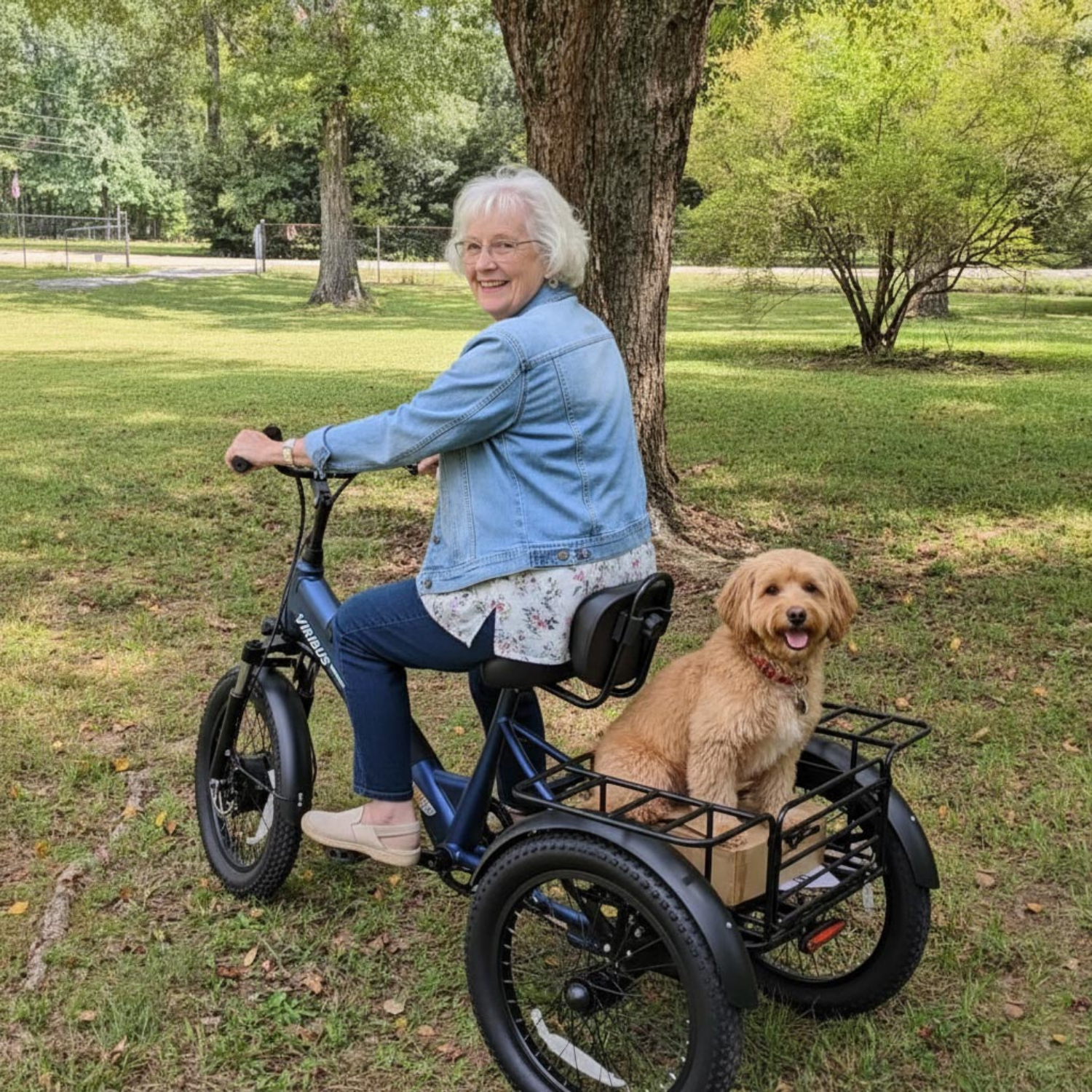
Sturdy metal or wooden baskets mounted over the rear axle provide a wide, stable platform to transport groceries, pet carriers, or heavy cargo without tipping. |
|
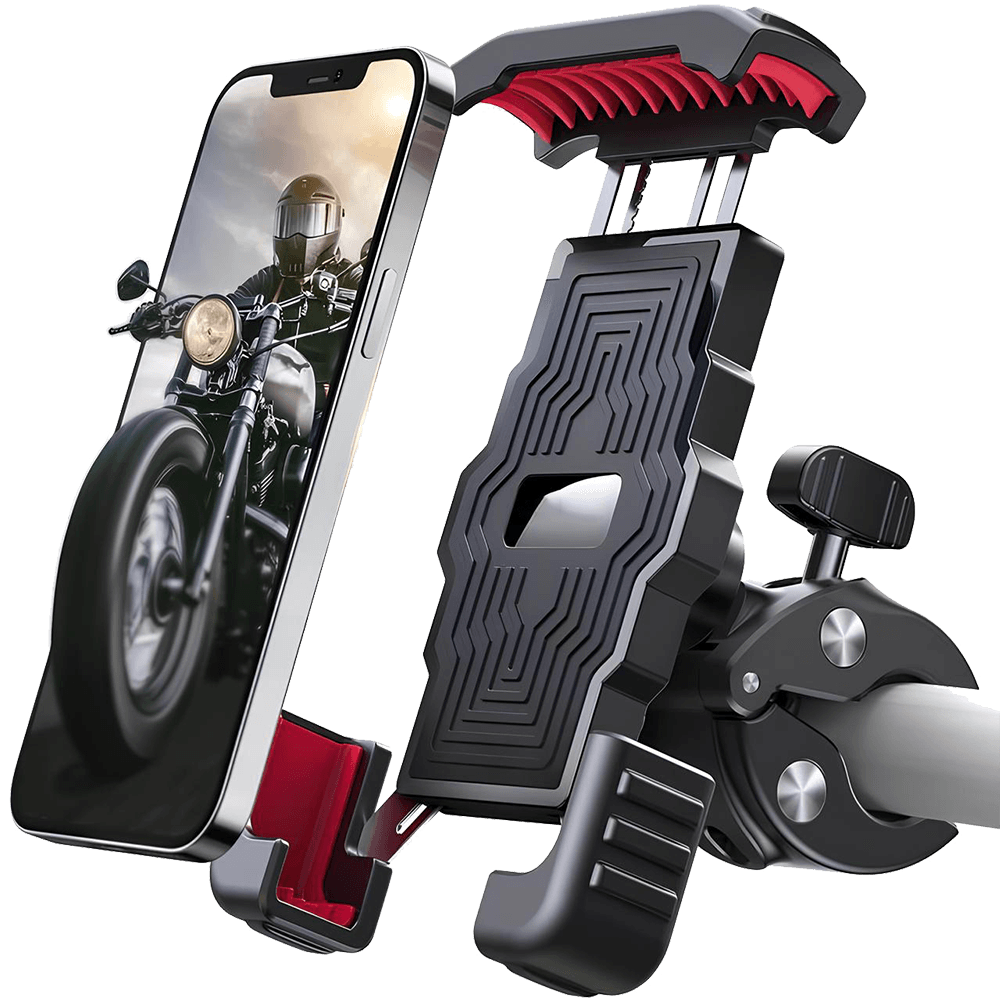
Handlebar-mounted clamps securely position your smartphone for easy GPS navigation, tracking ride stats, or hands-free calls. |
|
|
Weatherproof panniers and trunk bags fit neatly inside or alongside your baskets, keeping personal belongings, tools, and electronics dry in the rain. |
Conclusion
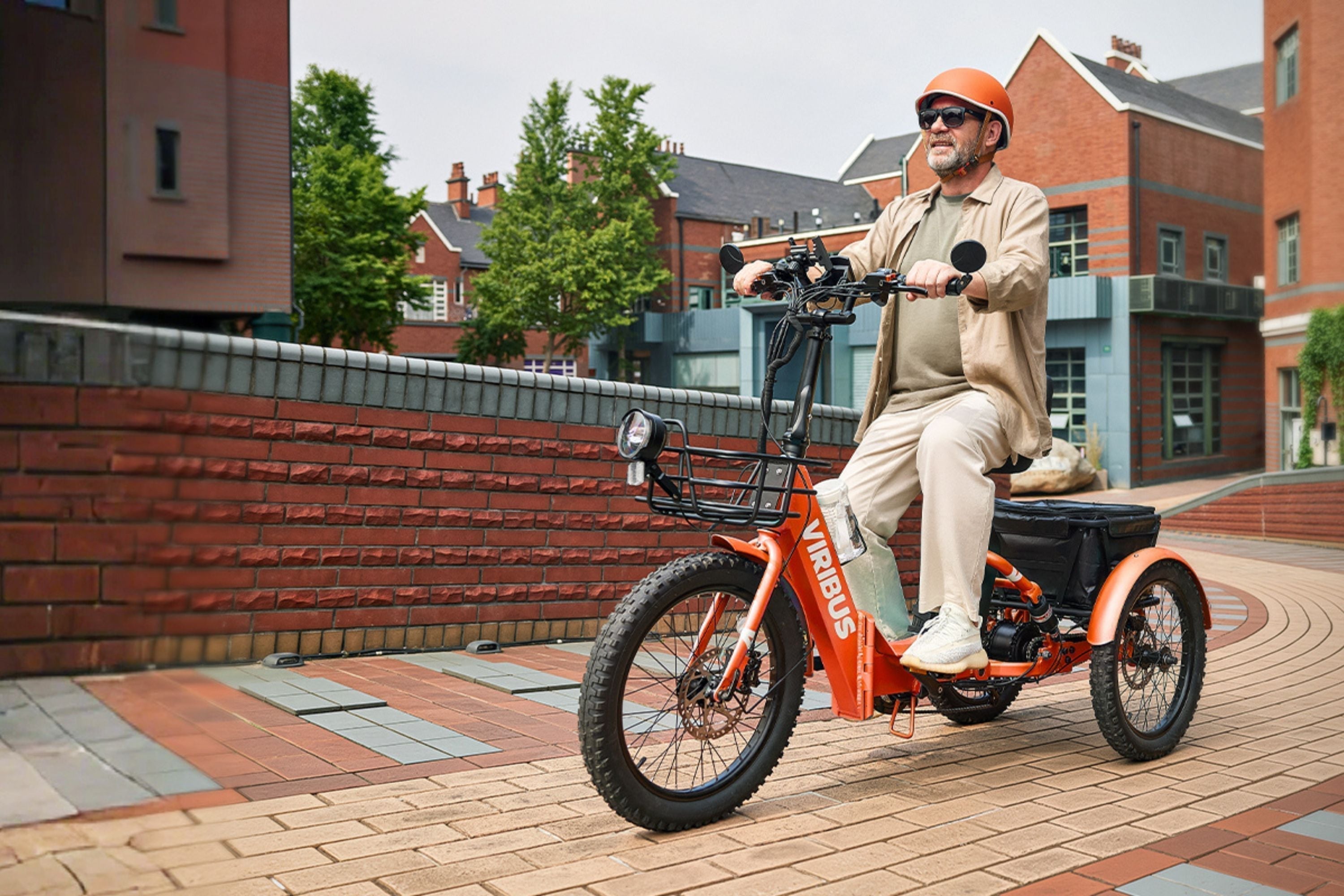
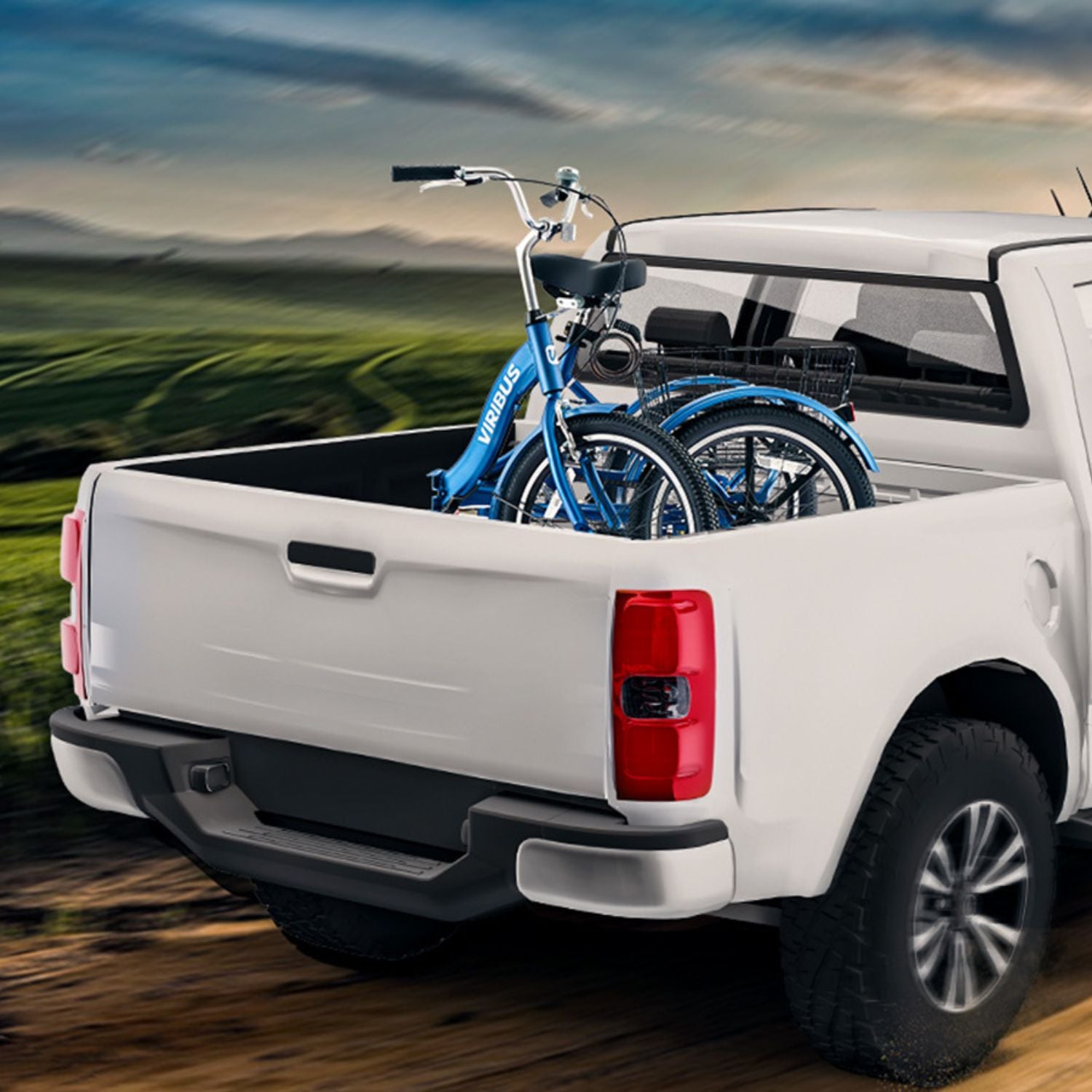
By assessing how these components work together, you can choose an electric trike built for long-term reliability and everyday comfort. Viribus Bikes offer purpose-built electric tricycles designed with fully integrated components—combining low step-through frames, built-in dual baskets, sturdy disc braking, and versatile wheel configurations.
Whether you are looking for an accessible daily commuter, a recreational cruiser, a folding storage model, or an all-terrain cargo hauler, matching the right specs to your routine ensures a smooth, stable, and enjoyable ride for years to come.













Leave a comment
All comments are moderated before being published.
This site is protected by hCaptcha and the hCaptcha Privacy Policy and Terms of Service apply.