











Electric bikes have transformed how we move, but their powerful lithium-ion batteries require serious safety oversight. With e-bike battery fires on the rise, cities like New York now legally mandate rigorous safety standards for all local e-bikes.
In response, brands are flooding the market with terms like "UL Certified," "UL Listed," and "UL Compliant." But here is the catch: these terms do not mean the same thing. Confusing a strict safety certification with a clever marketing buzzword can be a dangerous mistake.
This guide cuts through the noise. You will learn what UL certification ebikes actually means, which specific standards matter for e-bikes, how to verify them, and how to make a safer buying decision.
What Does UL Certified Mean for an Electric Bike?

When you see a safety badge on an electric bike, it’s not just a decorative sticker, it is a literal shield against electrical and thermal hazards. To truly understand why these safety marks carry so much weight, it helps to understand the organization behind them and what happens to a bike inside a testing laboratory.
What Is UL?
UL, which stands for Underwriters Laboratories, is an independent, global safety science organization. Founded in 1894 as the Underwriters’ Electrical Bureau, UL was created by MIT graduate William Henry Merrill Jr. after he was hired to assess fire risks at the 1893 Chicago World’s Fair. Merrill realized the critical need for a centralized, independent laboratory to test electrical systems for fire safety before they ever reached the public.
Today, UL is one of the world's most trusted third-party testing organizations. They do not manufacture products; instead, they develop strict safety standards and put consumer goods through grueling physical trials to make sure they are safe for everyday use.
In the United States and internationally, the UL mark is the gold standard for safety. It appears on over 22 billion products annually. Because it is independent of manufacturers, consumers and regulators know they can trust a true UL seal of approval.
What Does UL Certification Actually Test?
For an e-bike to earn a full UL certification (specifically the comprehensive UL 2849 standard), engineers do not just look at the battery. They evaluate the e-bike’s entire electrical drivetrain as a single, unified system—testing how the parts interact under extreme stress.
Here is exactly what UL evaluates and protects against during testing:
1. What They Evaluate
- The Battery: Tested for cell stability, construction, and structural integrity under pressure.
- The Charging System: Ensuring the charger communicating with the battery cuts off power perfectly when the cells are full.
- Wiring and Connectors: Inspected for heavy-duty insulation, proper grounding, and secure connections to prevent water ingress or fraying.
- The Motor and Controller: Tested to handle sustained electrical loads and high operating temperatures without melting or malfunctioning.
How Long Does an Ebike Battery Last?
Your Ebike Battery is Draining Too Quickly? 6 Reasons
2. Hazards They Protect Against
- Overcharging: If a charger fails to stop sending current to a full battery, the battery can fail. UL tests ensure multiple redundant safety switches cut the power.
- Short Circuits: UL tests simulated damage to the wiring to ensure the system immediately shuts down rather than sparking or catching fire.
- Thermal Runaway: This is the rapid, self-heating chain reaction that causes lithium-ion batteries to explode. UL subjects battery packs to impact, crushing, puncture, and extreme heat tests to guarantee they resist collapsing into thermal runaway.
- Fire & Electrical Shock Hazards: By assessing the insulation, heat dissipation, and plastic housing materials, UL ensures that the bike remains completely safe to touch and charge, even in wet environments.
Which UL Certifications Matter for E-Bikes?
Not all safety labels are created equal. When researching electric bikes, you will most frequently encounter two distinct certifications: UL 2849 and UL 2271.
While they work hand-in-hand, they serve different protective roles:
- UL 2849 tests the entire electrical system as a single, interactive unit.
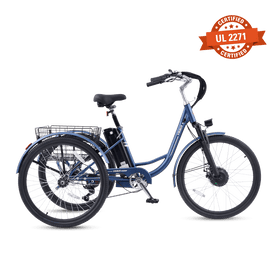
- UL 2271 focuses strictly on the engineering and durability of the lithium-ion battery pack itself.
To achieve the highest level of protection, experts recommend choosing an e-bike that holds both certifications. This pairing ensures that your high-capacity battery is structurally shielded, and your bike's overall electrical system is built to prevent compatibility errors, overheating, and fire risks.
UL 2849: Complete E-Bike Electrical System Certification

UL 2849 is the definitive safety standard engineered specifically for electric bicycles. Because an e-bike's motor, controller, battery, and charger are constantly sharing electrical current, evaluating them in isolation is not enough. UL 2849 ensures these components function safely together under real-world stress.
During certification, the complete drivetrain undergoes brutal laboratory testing simulating years of heavy use, environmental exposure, and unexpected system failures.
What UL 2849 Evaluates:
- The Battery System: Verifies that the battery safely integrates with the bike's onboard electronics and shuts down during overcurrent or voltage spikes.
- The Battery Charger: Confirms the charger supplies the correct voltage and communicates perfectly with the battery to prevent overcharging.
- Wiring and Connectors: Evaluates cables and harnesses to ensure they can handle high currents without melting, fraying, or short-circuiting.
- The Motor Controller: Tests the system's "brain" to make sure it regulates power smoothly and protects against sudden power surges.
- The Electric Motor: Subjects the motor to intense loads (like prolonged hill climbing) to ensure it dissipates heat safely.
Key Safety Tests Included in UL 2849:
- Short-circuit and overcurrent protection
- Thermal runaway and overheating resistance
- Moisture exposure and water-resistance testing
- Mechanical vibration and structural stress testing
- Shock hazard prevention
Many e-bike fires do not stem from a single broken part; they are caused by system incompatibility—like using a charger that pushes more voltage than the battery's management system can handle. Because UL 2849 certifies the entire ecosystem, it is recognized by major city regulators, insurers, and safety advocates as the ultimate benchmark for complete e-bike safety.
UL 2271: Lithium-Ion Battery Certification

While UL 2849 looks at the big picture, UL 2271 zeroes in on the highest-energy component: the lithium-ion battery pack. This standard establishes strict requirements to guarantee the battery can withstand mechanical abuse, vibration, and climate shifts without failing.
How NFC Keyless Access and UL2271 Certification Boost Your Ride's Safety
What UL 2271 Evaluates
- Pack Construction: Ensures the outer casing is physically robust, flame-retardant, and securely houses the individual cells.
- Thermal Stability: Verifies that if one cell overheats, the battery's architecture prevents a domino effect (thermal runaway) from spreading.
- Impact and Drop Resistance: Simulates crashes, heavy potholes, and accidental drops to confirm the battery won't spark or rupture under impact.
- Water and Moisture Resistance: Evaluates seals to ensure rain, road spray, or puddles cannot seep inside and trigger a deadly internal short circuit.
- Internal Cell Protection (BMS): Tests the electronic Battery Management System to ensure it successfully detects and stops overcharging, deep discharging, and overheating.
Relying on a single safety badge leaves blind spots. A UL 2271 battery is incredibly tough, but it cannot prevent a poorly insulated motor controller or a cheap, uncertified charger from causing a system-wide electrical fire. Conversely, a UL 2849 system runs safer when powered by a battery pack that has been independently crushed, dropped, and water-tested to UL 2271 standards.
Why Is UL Certification Becoming More Important?

In the early days of the electric bike boom, UL certification was often viewed by manufacturers as an expensive, optional badge. Today, it has rapidly shifted from a luxury marketing point to an absolute necessity.
Two driving forces are behind this shift: a sharp rise in dangerous battery fires and a wave of new safety regulations.
Growing Number of Battery Fires
The main driver behind the push for UL standards is the rising frequency of lithium-ion battery fires. While well-engineered electric bikes are incredibly safe, the market has been flooded with cheap, uncertified alternatives.
Major cities worldwide have recorded record-high numbers of e-bike and e-scooter fires. In places like New York City, dozens of injuries and multiple fatalities have been directly linked to malfunctioning micromobility batteries.
Unlike typical fires, lithium-ion battery fires are chemical events. When a low-quality cell fails, it can trigger thermal runaway—a chain reaction where the battery rapidly self-heats, exploding into an intense, self-oxygenating fire that cannot be easily extinguished with water.
A significant percentage of battery fires are caused by cheap aftermarket batteries, mismatched chargers that overcharge the cells, or DIY conversion kits purchased from unregulated online marketplaces.
New Safety Regulations
Because of these rising safety hazards, governments, landlords, and educational institutions are stepping in with strict rules to keep uncertified batteries out of buildings.
Are Electric Bikes Street Legal?
- New York City's Landmark Law: NYC became the first major U.S. city to take a hard legal stance. The city explicitly bans the sale, lease, or rental of any e-bike, e-scooter, or light electric vehicle battery that does not meet UL 2849 or UL 2271 standards.
- Statewide Momentum (California SB 1271): Following New York's lead, California enacted Senate Bill 1271. This law mandates that any e-bike, battery, or charging system sold or leased within the state must be tested and certified by an accredited laboratory to meet UL 2849 or equivalent safety standards. Other states and municipalities are actively drafting similar legislation.
- Institutional Bans: Even in places without local laws, the private sector is acting fast. An increasing number of apartment complexes, office buildings, and major universities now ban non-UL-certified e-bikes from being brought indoors or charged on-site. For many riders, owning a UL-certified bike is no longer just about safety—it is the only way they are legally allowed to store and charge their ride at home or work.
UL Certified vs. UL Listed vs. UL Compliant

When you are comparing electric bikes, the technical jargon on product pages can quickly become confusing. Brands frequently toss around terms like "UL Certified," "UL Listed," and "UL Compliant" as if they are interchangeable.
In the world of battery safety, however, these terms have vastly different meanings. Knowing how to tell them apart is the difference between a genuinely safe battery and a marketing trick.
|
Term |
Meaning |
Verification |
|
UL Certified |
An umbrella term (and an enhanced modern safety mark) indicating a product has been officially tested by UL or an authorized third-party certification body to meet strict national safety standards. |
Easy to verify using the certifying body's online public database. |
|
UL Listed |
The traditional, widely recognized safety mark indicating that a finished, standalone consumer product has been thoroughly tested by UL and found to meet all applicable safety standards. |
Easy to verify; the product will carry the distinct "UL in a circle" mark and appear in the UL database. |
|
UL Compliant |
A manufacturer's self-declaration claiming their product was built to meet UL safety guidelines, though no independent laboratory has actually tested or verified it. |
Hard or impossible to verify; typically lacks a third-party UL database file or a physical certification mark. |
If an e-bike listing says "UL Compliant," your safety alarm bells should go off.
Unlike "Listed" or "Certified" designations, "UL Compliant" is a self-declared claim made by the manufacturer. It means the brand claims they designed the bike or battery according to UL standards, but they never actually sent it to an independent lab to verify those claims.
How to Verify if an Electric Bike Is Actually UL Certified

With some manufacturers using misleading marketing terms or even applying unauthorized safety badges, you should never just take a brand's word for it. Verifying an e-bike's UL certification is simple if you know where to look and how to use public safety databases.
Step 1: Check the Certification Label
The first physical step is to inspect the bike and its components for official safety marks. A truly certified electric bike will have physical labels permanently affixed to it.
- The Frame (often on the down tube): Look for a sticker or plate displaying the UL Certified or UL Listed logo alongside the specific standard number, UL 2849.
- The Battery Pack: The battery should feature its own label, typically displaying the UL 2271 standard.
- The Charger: Check the charging brick for a holographic or printed NRTL (Nationally Recognized Testing Laboratory) safety mark.
Look for the certifying body's logo (such as UL, SGS, TUV, or Intertek/ETL) accompanied by a File Number (usually starting with an "E", like E123456).
Step 2: Search the Public Database
If a brand claims their bike is certified, their exact model must be listed in an official, public database. If it is not in the database, it is not certified.
1.Go to the database
Visit the official UL Product iQ database at productiq.ul.com. You can search the abridged site for free without creating an account. (If the bike was certified by another NRTL like Intertek/ETL or TUV, go to their respective directory).
2.Search by manufacturer or file number
Enter the manufacturer's official corporate name (which is sometimes different from the brand name) or the UL File Number (the "E" number) found on the bike's label.
3.Confirm the exact UL Standard
Ensure the listing explicitly mentions UL 2849 (for the whole bike system) or UL 2271 (for the battery pack).
4.Match your specific model
Open the certification document within the database and confirm that your exact e-bike model name or number is explicitly listed under the certified models.
Step 3: Ask the Manufacturer Directly
If you cannot find a database listing or want to be absolutely certain before purchasing, contact the e-bike manufacturer directly.
Ask their customer support team to provide the following:
- The Certificate of Compliance (CoC): This is the official document issued by the testing laboratory confirming the product successfully passed all safety trials.
- The Testing Laboratory Name: Ask which specific NRTL performed the test (e.g., UL, TUV, Intertek).
- The Certification File Number: Ask for the unique database file number so you can instantly verify it yourself on the testing laboratory's site.
If a manufacturer refuses to provide these details, claims the documents are "confidential proprietary information," or sends a certificate that only covers a single sub-component (like the charger wall plug), the e-bike is highly unlikely to have a genuine, system-level safety certification.
Are Third-Party Certifications Acceptable?

When shopping for an electric bike, you might see safety badges from organizations other than Underwriters Laboratories. For example, a brand might advertise that their bike is certified to UL standards by Intertek (ETL) or SGS.
This often leaves buyers asking: Is a product still safe if UL didn't do the actual testing?
The short answer is yes. In fact, legally and physically, third-party testing by an accredited laboratory is just as valid as a certification directly from UL.
The U.S. Occupational Safety and Health Administration (OSHA) maintains a list of official, independent laboratories called Nationally Recognized Testing Laboratories (NRTLs). These laboratories are legally authorized by the federal government to test and certify products to various safety standards.
While Underwriters Laboratories (UL) writes and publishes the safety standards (like UL 2849 or UL 2271), they do not hold a monopoly on testing. Any approved NRTL is legally permitted to test a manufacturer's e-bike against those exact same UL standards.
Common, highly reputable NRTLs you will see include:
- Intertek (which issues the "ETL Listed" mark)
- SGS
- TUV Rheinland or TUV SUD
- CSA Group (Canadian Standards Association)
UL Listed/Certified
This means the product was physically tested by Underwriters Laboratories inside a UL facility and carries the official "UL" logo.
Tested to UL Standards (by an NRTL)
This means a different accredited laboratory (like Intertek or SGS) put the product through the exact same physical trials mandated by the UL 2849 or UL 2271 rulebooks. The product will carry the certifying lab's mark (such as the ETL mark) rather than the UL logo.
There is no technical difference in safety between a product that is "UL Listed" and one that is "ETL Listed" to the same UL standard. Both labs use the exact same test protocols, safety limits, and quality audits. Manufacturers often choose alternative NRTLs because they can sometimes process testing faster or more cost-effectively than UL.
Benefits of Buying a UL-Certified Electric Bike

Investing in a UL-certified electric bike is about more than just checking a legal box—it directly impacts your daily ownership experience. Opting for a certified model offers major advantages across safety, durability, and daily peace of mind.
Improved Fire Safety
The primary benefit of a UL-certified e-bike is a drastically reduced risk of catastrophic battery failure.
- Preventing the Domino Effect: Certified lithium-ion batteries are designed with robust physical barriers and intelligent Battery Management Systems (BMS). If an individual battery cell suffers a defect, the system is engineered to isolate the heat and prevent a domino effect—stopping a localized failure from turning into a full-blown thermal runaway event.
- Active Fault Protection: A certified electrical system constantly monitors the temperature, voltage, and current during charging and discharging. If it detects an overload, a short circuit, or a sudden temperature spike, it instantly cuts the power.
Better Long-Term Reliability
UL standards do not just test a product's safety on day one; they simulate years of intense, real-world wear and tear.
- Extreme Weather Durability: To pass testing, components must prove they can withstand severe temperature swings, intense humidity, and direct moisture exposure without degrading or losing insulation.
- Physical Vibration Isolation: E-bikes encounter constant bumps, potholes, and debris. Certified systems are subjected to heavy mechanical shaker tests to ensure wires won't shake loose, connectors won't crack, and battery cells remain structurally secure over thousands of miles.
Easier Insurance and Building Compliance
As battery safety concerns grow, carrying a UL certification is increasingly becoming a practical requirement for living with an e-bike.
- Access to Buildings: An increasing number of landlords, residential apartment complexes, office towers, and universities are banning non-certified e-bikes from being brought indoors or charged on-site. Owning a certified bike is often the only way you can legally and cooperatively store your ride at home or work.
- Insurance Approvals: Many renter's, homeowner's, and commercial insurance policies are adjusting their terms to limit coverage for damages caused by uncertified lithium-ion devices. A UL-certified bike protects your personal liability and ensures your property remains fully insurable.
Greater Peace of Mind
Perhaps the most valuable benefit is the mental relief of knowing your e-bike is safe, especially during the most vulnerable times.
Most riders charge their electric bikes indoors, often overnight or while they are asleep. When you ride a bike with a fully certified electrical system and battery, you don't have to worry about leaving it plugged in. The rigorous third-party testing guarantees that multiple redundant safety shut-offs are actively monitoring your battery, giving you total peace of mind every time you plug it into the wall.
Is a UL-Certified E-Bike Worth the Extra Cost?
Absolutely. When you factor in the physical, legal, and long-term financial realities, a UL-certified e-bike is worth every extra penny. Getting a full UL 2849 (complete system) or UL 2271 (battery pack) certification is an expensive process for manufacturers—often costing tens of thousands of dollars in destructive lab testing and forcing them to source premium, tier-one battery cells (like Samsung or LG) rather than cheap, generic alternatives.
This raises the upfront retail price of a certified bike by about 15% to 30%, but that cost is essentially a lifetime insurance policy against catastrophic thermal runaway—a violent, self-oxygenating chemical fire that standard water fire extinguishers cannot put out.














Leave a comment
All comments are moderated before being published.
This site is protected by hCaptcha and the hCaptcha Privacy Policy and Terms of Service apply.