


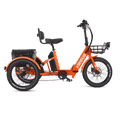


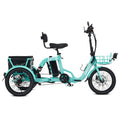

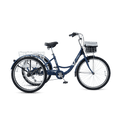


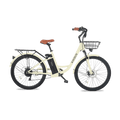





If you're buying an electric trike for a parent or grandparent this holiday season, look for a low step-through frame, a battery with proper safety certifications, a height range that actually fits your parent, and a deal you can lock in before Cyber Monday wraps up. That's the formula. A good electric trike gives older adults back the grocery runs, the coffee loops, and the easy independence they've quietly stopped asking for. No balancing, no straining, and in many states, no license or registration to sort out.
The tricky part isn't wanting one. It's knowing which one to get, and knowing what the first month actually looks like. Because the gap between the brochure and the driveway is where most gift trikes either earn their keep or end up under a tarp.

Why a Trike Beats Another Sweater and Most Other Big Gifts
Plenty of well-meaning gifts gather dust by February. A trike is different, and not just because it's bigger than a breadbox:
Balance works differently on three wheels
A rider doesn't have to hold the trike upright at stops the way they would on a two-wheeler. That's the whole point. But three wheels do not erase every stability concern. One Viribus TG1 owner who had been riding two-wheelers for eight years wrote that he "nearly tipped over on my first turn." Slow down before turns, watch for uneven pavement, and get comfortable with the handling before riding near traffic. A public review of the FC1 put a finer point on it: one tester said the trike "starts to tip when turning at just 6 mph." Treat the first few rides as a handling course, not a commute.
Hills stop being a dealbreaker, if the motor matches the terrain
Pedal assist quietly does the ugly work on inclines and headwinds. A 65-year-old rider who tested a Viribus trike for two months found the 250W motor "provides a nice little boost" for store and park runs. But a third-party test of the FC1 found testers "fail to reach the claimed 20 mph, topping out between 15 and 18 mph." Worth knowing if your parent lives somewhere with long, steep grades and expects a certain pace.
It eats short car trips
Pharmacy, post office, grocery run. Plenty of everyday errands happen within a couple miles of home. That's trike territory, not car territory.
It buys back independence
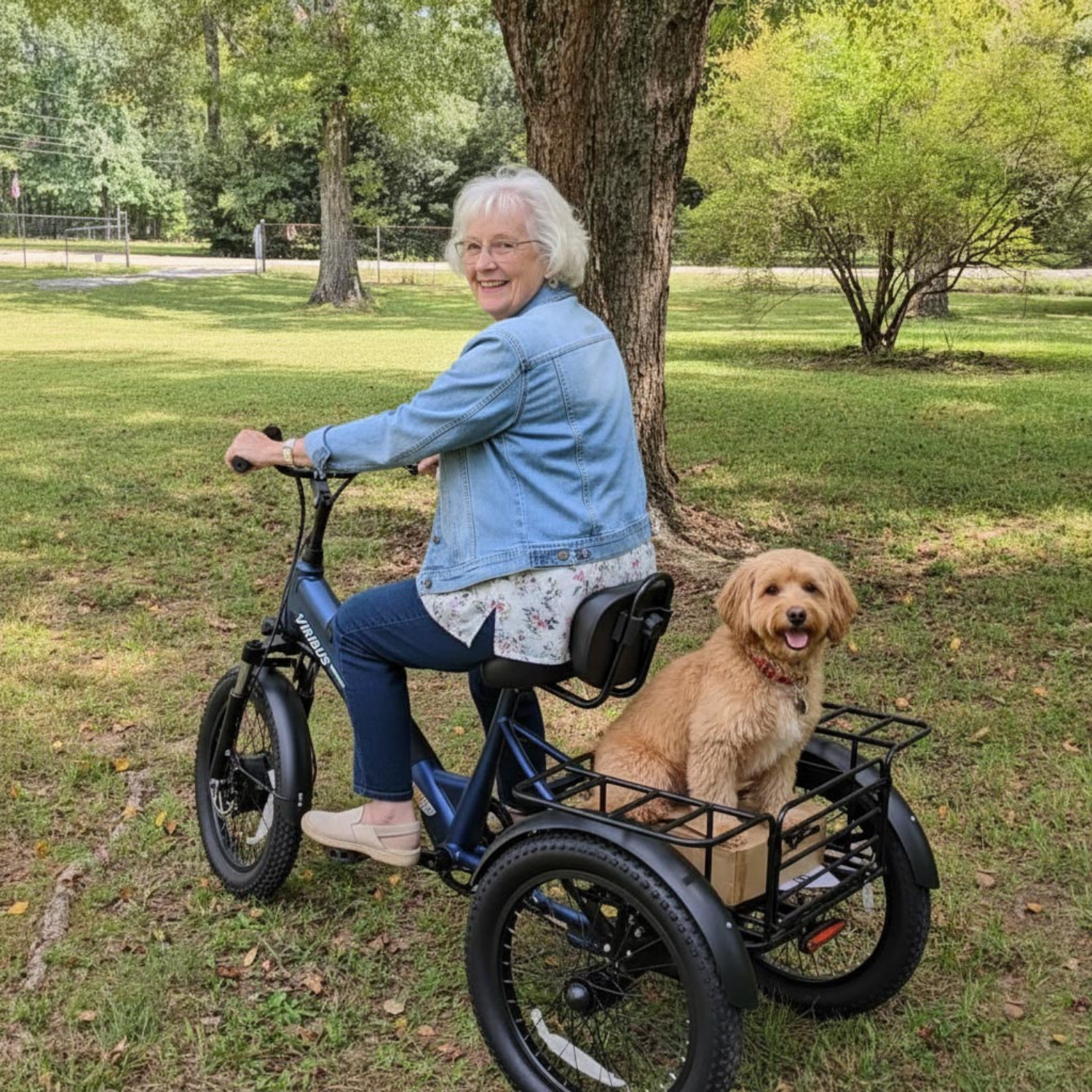
For parents who've cut back on driving, a trike can put some of those short trips within reach again. The same 65-year-old rider put it simply: "As an older rider, I feel very stable and safe on this tricycle."
First, Figure Out How Your Parent Will Actually Use It
Be honest here, because this decision shapes everything else. Where do they live, and what would they actually ride to?
Mostly neighborhood stuff
Grocery store a mile away, church on Sundays, coffee with friends. The Viribus TG1 fits this life on paper. But the first month with a TG1 includes a few friction points that no spec sheet mentions. The box alone is "around 80-something pounds," and the owner who documented his first 30 days wrote plainly: "If you live alone, get someone to help you carry it inside." Assembly is advertised as 85% pre-assembled, but the front wheel install is where first-timers lose time. His fix was embarrassingly simple: watch the assembly video all the way through before starting. If you're giving this as a gift, watch that video yourself before Christmas morning.

Hills, trails, longer weekends
If they live somewhere with real terrain or they're the adventurous type, motor and tires matter more than the price tag. The Viribus FC1 Folding Electric Tricycle is built for that use, but a public third-party test logged a few things worth knowing: the battery mounts "wobble on two test bikes," the suspension seatpost "bottoms out" under a 200 lb rider even at its stiffest setting, and the trike lacks a reverse mode, a genuine inconvenience for anyone who needs to back out of a tight garage. None of these are dealbreakers for every rider, but they separate "spec-sheet match" from "actually matches how Mom will use it."
Tight garage, or they winter down south
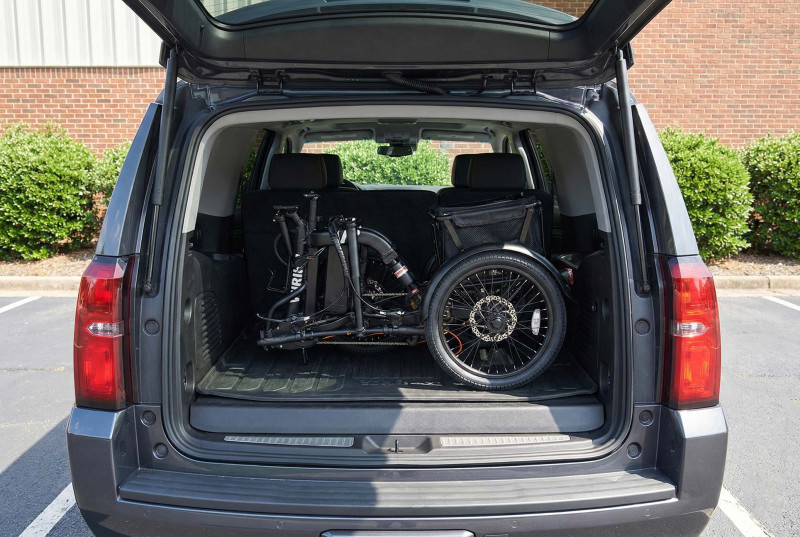
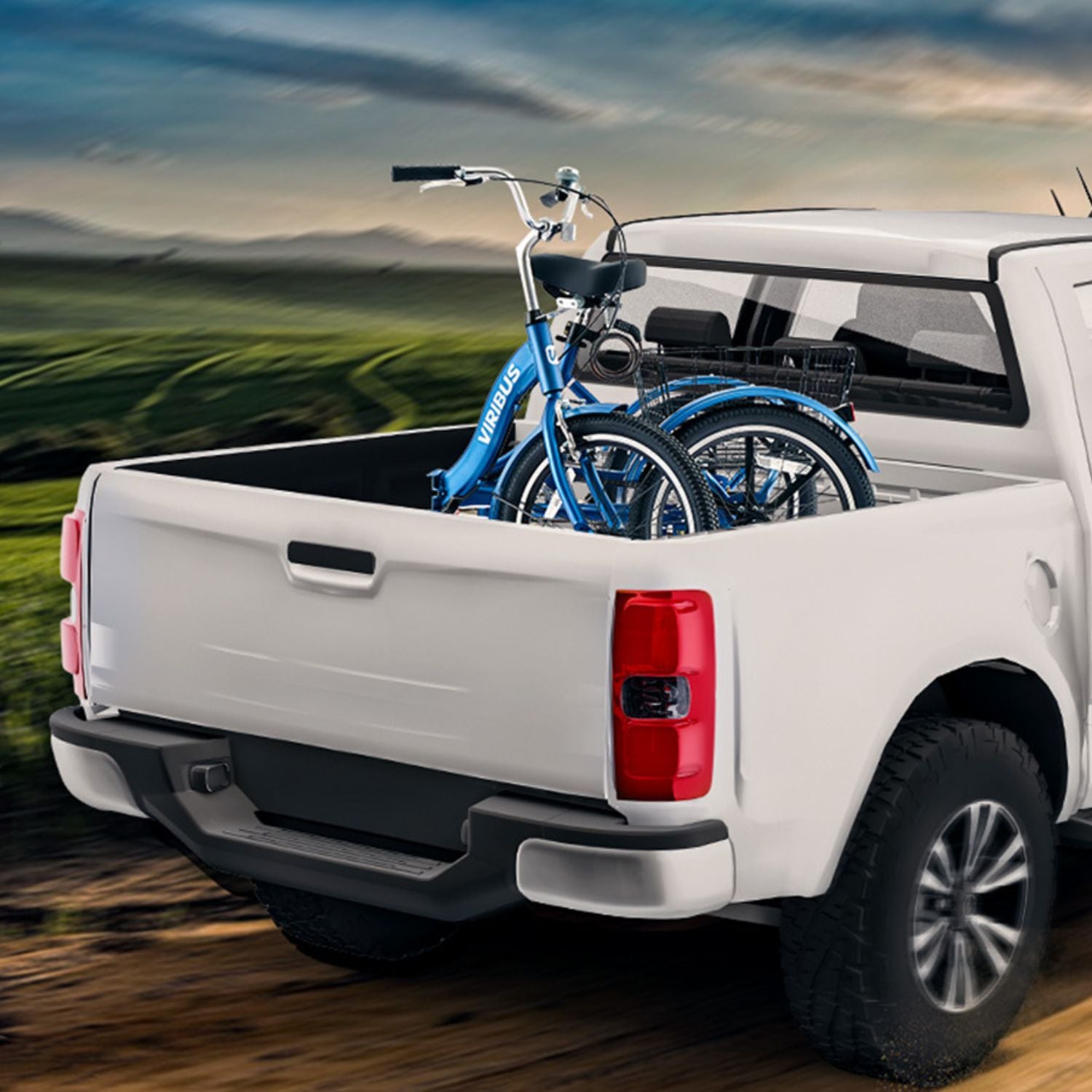
Folding helps, but it is not a magic trick. One FC1 reviewer noted that "the weight makes folding difficult, and the folded trike is bulky." The folding mechanism solves the storage footprint, not the lifting problem. Before assuming a folding model fits your trunk, weigh the folded unit against what your parent can realistically lift, and measure the trunk opening, not just the folded dimensions.
Don't Skip the Battery Certification Stuff
Specs are boring. But this is the one I'd refuse to compromise on, especially for an older rider.
Battery fires make headlines for a reason, and uncertified packs are usually the culprit. But product listings get confusing: UL 2271 and UL 2849 are not the same certification. UL 2271 covers the battery itself; UL 2849 covers a vehicle's whole electrical system. A certified battery does not mean the entire trike is certified. Some cities, New York is the strictest, now require certified e-bikes and batteries for legal sale, so it's worth knowing which standard applies to which part.
So check the certification scope for the specific model before ordering, ideally on that model's own product page, since a collection-level badge won't tell you whether the battery alone is listed or the whole electrical system is. That distinction matters, and it's the kind of thing worth confirming per model rather than inferring from a page title.
Beyond the battery, four things worth checking:
- Disc brakes on every wheel, so stopping power is never a question.
- A parking brake, which makes getting on and off feel steady.
- Built-in lights, because winter days are short.
- A low center of gravity, which keeps turns feeling planted and makes the "6 mph tipping" warning above less likely to become your parent's first story.

Size and Storage Are Where Most Gifts Go Wrong
The most common sizing mistake is guessing. A trike built for a shorter rider leaves a taller one cramped; one that's too big can be hard to mount safely. Don't skip this step.
Get their height. Every model lists a rider height range. The TG1 folding trike covers 4'11" to 6'2"; the FC2 goes 4'9" to 6'5"; the compact 16-inch folding model fits 4'6" to 5'5". Match it, then double-check the seat adjusts within that range.
Check weight capacity honestly, including the box weight. Add the rider's weight plus whatever rides in the basket. But also account for the fact that the trike itself is not light. The TG1 shipping box is 80-something pounds; the FC1 is around 129 lbs and the FC2 around 128 lbs. A folding model that fits in the trunk is useless if your parent cannot lift it into the trunk without help.
Measure where it will live and where it will be assembled. A standard trike takes up roughly a bicycle's footprint plus basket depth. But assembly space matters too. One Trustpilot reviewer of the TG1 Pro 350W described bolts falling out of the box during unpacking and a rear tire chain that arrived "assembled around the body of the bike," requiring a chain tool to correct. Give yourself a clear, well-lit area and budget more time than the manual suggests.
Think about mounting. Step-through frames let a rider sit down without swinging a leg over anything, a genuine kindness for stiff hips and knees. The 65-year-old tester specifically called out the step-through frame as what made mounting the trike simple and comfortable.
Range, Motor Power, and the Charging Habit
Here's where marketing numbers and driveway reality part ways:
Real range is lower than the spec sheet, and riders confirm it. Viribus lists pedal-assist range from roughly 37–44 miles on the TG1 up to about 75 on the ST1. But one independent test of the TG1 put real-world range at 25–30 miles depending on assist mode. The same 30-day TG1 owner recorded a specific behavior worth knowing: riding with under 20% battery, the motor's power drops noticeably. The trike doesn't die, but a hill that was easy at 60% suddenly demands real pedaling. Treat the official number as a best case, and plan charging around the low-battery behavior, not the full-battery feel.
Motor power should match the riding, not the marketing. Lower-watt motors are fine for flat neighborhoods; the 65-year-old rider found 250W sufficient for store and park loops. But hilly terrain, heavier loads, or taller riders justify stepping up. And check throttle engagement behavior: the FC1's motor takes three to four seconds to re-engage after braking, and testers experienced "ghost pedaling" from PAS level 3, meaning the pedal assist can feel disconnected from what the rider's legs are actually doing.
The charging habit. Most batteries fill up in 4–8 hours on a normal wall outlet. The riders who never think about range are the ones who plug in after every ride. One caveat from the 30-day log: the battery is removable, and that matters more than it sounds like it should. If your parent parks in a cold garage or has to carry the battery up a flight of stairs, a removable pack turns a chore into a habit.
Winter note: lithium batteries lose noticeable capacity in freezing weather, and charging a deeply chilled battery is hard on it. If your parents ride through real winters, bring the battery indoors between rides and let it come to room temperature before charging. Small habit, big difference.
What a Good Trike Should Cost This Month
Quality adult electric trikes generally land between $400 and $1,100, and the holiday window compresses that range hard. Here's the current Viribus Black Friday lineup as a benchmark:
| Model | Body style | Best for | Holiday price |
|---|---|---|---|
| TG1 | Standard upright | Neighborhood errands, budget gift | From $399 |
| 16" Folding | Compact, 2-seat option | Shorter riders (4'6"–5'5"), easy storage | $439 (sold out at time of writing) |
| TG1 Folding | Folding upright | Garages and closets, 4'11"–6'2" | $699 |
| FC2 | Folding, all-round | Most riders, 4'9"–6'5" | $899 |
| FC1 | Folding, all-terrain | Hills, trails, taller riders | $999 |
| ST1 | Folding, premium comfort | Long rides, 5'0"–6'3" | $1,099 |
My honest take: pay up only for what the riding actually demands. Hills and trails justify the FC1's price. Everything else on that table delivers the same core thing, stable, motor-assisted independence, at whatever budget fits. But the price of a trike is not the only cost. Assembly time, a possible professional tune-up, and the chance you'll need to contact support in the first month are part of the real number. Public user feedback on Viribus is mixed: some riders describe responsive customer service that "quickly sent replacement parts" when a fender arrived bent, while others report slow or AI-driven first responses and difficulty getting a real person on the line. Neither experience is universal, but both are common enough that it belongs in a buying guide, not a footnote.

Folding or Standard? Storage Decides, Not Preference
Plenty of garage space, prefers a classic ride: standard upright. The TG1 is the friendly, familiar choice. It trades folding convenience for a more rigid frame, and for many riders that rigidity is the reassuring part. But it is not a light object: the shipping weight alone is in the 80-pound range, so set expectations for setup day accordingly.
Tight space, RV trips, or "we spend January in Florida": folding, with eyes open. The FC2 and ST1 fold down for storage and still ride like full-size trikes, but folding and lifting are different problems. The FC1 is around 129 lbs; the FC2 around 128 lbs. One FC1 reviewer summed up the trade-off plainly: folding helps with footprint, but "the weight makes folding difficult, and the folded trike is bulky." If your parent cannot lift a 128–129 lb object into a trunk or RV bay without strain, a folding trike may solve the storage question and create a new one.
Still torn? Browse both styles side by side and let the storage space, plus an honest conversation about who will be lifting it, make the call.
Three Things to Do Before You Hand Over the Keys
Assemble it yourself first, and watch the video before you start
Nothing kills a gift like watching Mom read a generic assembly manual on Christmas morning, especially when the manual may not match the exact model. One TG1 Pro 350W buyer found the instructions "seem like they're for 250W or more generic to make it usable for all the models," and had to correct a chain that arrived routed around the frame. The 30-day TG1 owner's single best piece of advice: "Watch the assembly video all the way through before you start. It'll save you at least 20 minutes." Build it, test-ride it, park it ready.
Plan the first ride together, and make it a handling lesson, not a victory lap
An empty parking lot, a quiet path, maybe a thermos of coffee. First rides go better with a coach alongside. Start with slow turns and deliberate stops; the first-turn tip-over risk is real, and a 6 mph turn is faster than it feels.
Make it complete, and make it honest
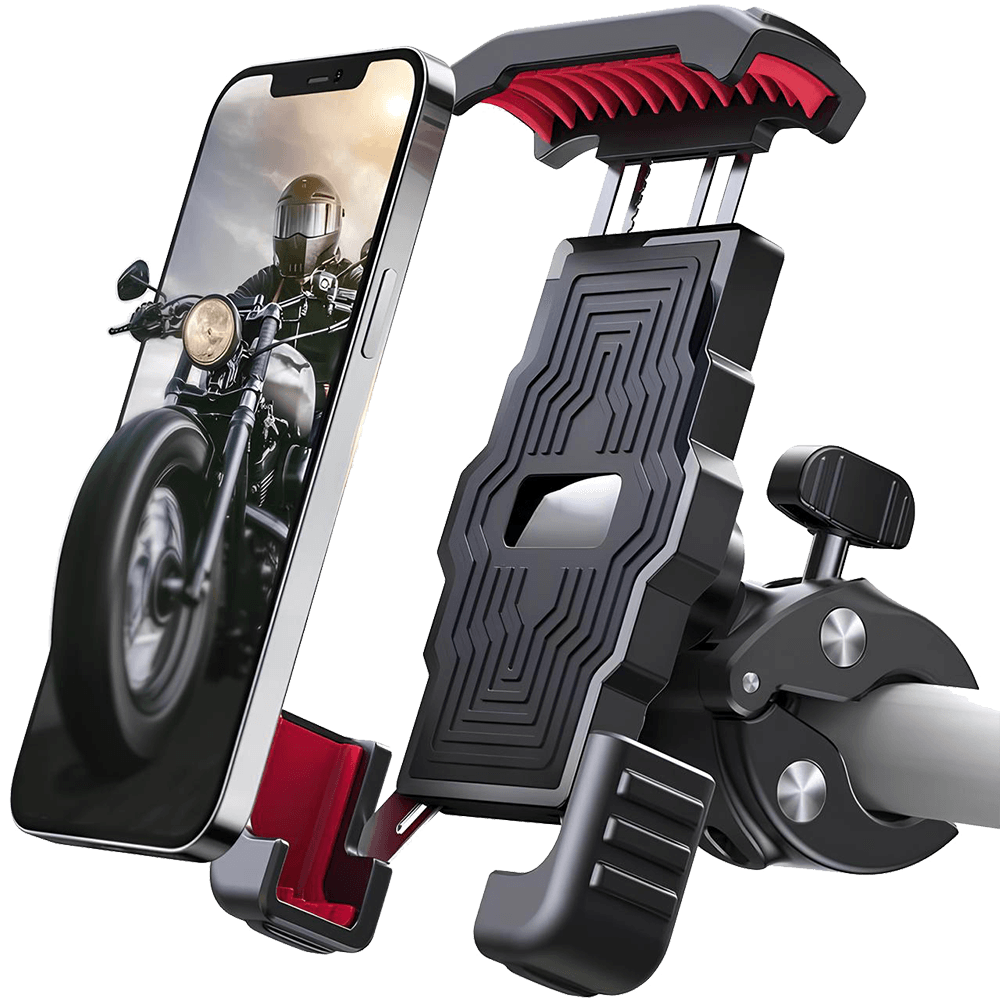
A helmet, a phone mount, maybe a basket liner. But also include a short note: here's what to check after the first week, here's how to reach support, and here's what the realistic range looks like on cold days. Small add-ons that say "this was meant for you" instead of "this arrived half-thought-through."
Common Questions Before You Buy
My mom hasn't been on a bike in 30 years. Is this realistic?
More realistic than you'd think, but "realistic" does not mean "effortless." A trike removes the need to balance at stops the way a two-wheeler does, and pedal assist means no straining. But an experienced two-wheel rider who switched to a TG1 admitted he "nearly tipped over on my first turn" and had to recalibrate his handling. Start her on flat, quiet streets with a step-through frame and a parking brake, and treat the first week as a learning curve, not a test.
Does my dad need a license or registration for this?
It depends on your state and the specific trike. Rules hinge on motor power, top speed, throttle setup, and how your state classifies three-wheeled electric vehicles. Check your state's e-bike and motor vehicle regulations before buying. Some cities, including New York City, also have certification requirements for electric bikes sold or used locally.
How do I figure out the right size without ruining the surprise?
You'd be surprised what people know about their parents' height. Get the number however you can: an old driver's license, a sibling, a casual measurement over Thanksgiving dinner. Match it against the model's height range, and when in doubt, size up and drop the seat. But also ask: who is lifting it? Size and weight are two different conversations.
How far can one charge actually take them?
It depends on the model. Official Viribus pedal-assist range runs from roughly 37 miles on the TG1 up to about 75 on the ST1. Independent testing of the TG1 put real-world range at 25–30 miles, and the motor's power fades noticeably below 20% battery. For a typical week of errands, that still means charging once or twice a week, but the low-battery feel is worth knowing before the first long ride.
Is the cheap one okay, or do I need the expensive one?
The $399 trike and the $1,099 trike share the same heart: three stable wheels and pedal assist. The pricier ones add folding frames, bigger batteries, stronger motors, and plusher comfort. Pay for what your parent's streets actually demand, and not a dollar more. But pay attention to the first-month experience, not just the sticker: assembly difficulty, instruction quality, and responsiveness of customer support show up in owner reports across the price range, including on the cheaper end.
When do I need to order to get it under the tree?
Black Friday and Cyber Monday tend to bring some of the year's better prices, and ordering early in the window keeps shipping ahead of the holidays. Before you order, compare the current sale price, stock status, delivery estimate, and return policy. Missed it? End-of-year clearance and January sales are the next best thing.
 Ready When You Are
This gift is a little different from most things on a holiday list. You're not handing over an object. You're handing back the coffee runs, the post office trips, the slow morning loop around the neighborhood. Pick the trike that matches how they actually live, insist on a certified battery, and build in the first-month reality: the assembly video, the handling practice, the honest range conversation. That's what turns a trike from a nice idea into the thing your parent actually rides.
Find Their Independence
Give the gift of a ride they'll actually use.
Browse the full electric tricycle collection, or start with models that carry UL certification if safety is your top concern.
Shop Electric Tricycles →












Leave a comment
All comments are moderated before being published.
This site is protected by hCaptcha and the hCaptcha Privacy Policy and Terms of Service apply.